
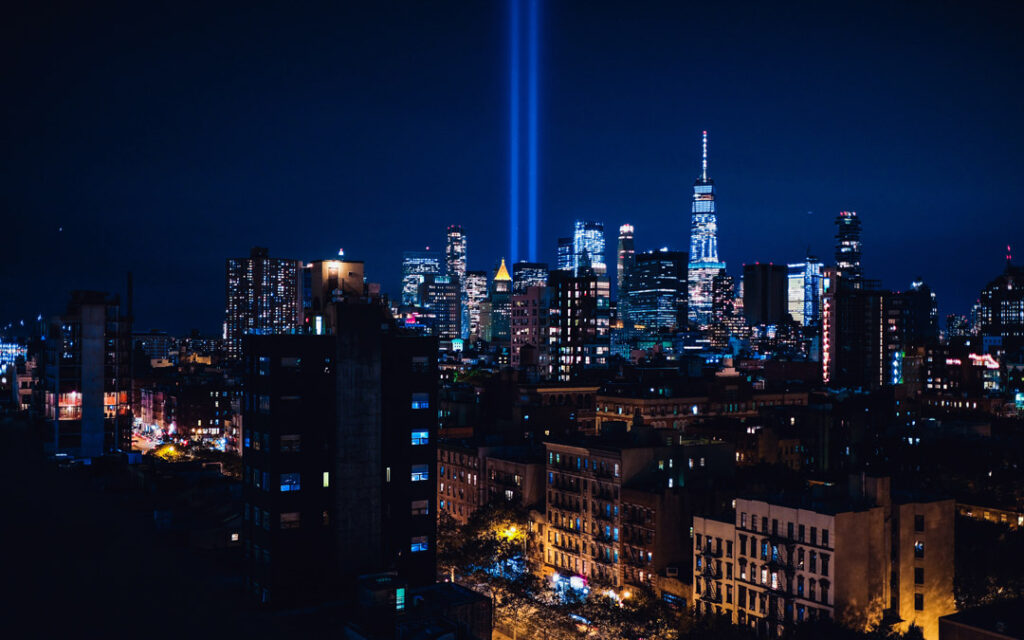
I watched the weekend coverage of the 20th anniversary of the 9/11 terrorist attacks, and it took me back to Lower Manhattan, to the park at Union Square, a few blocks from the holes in the earth that had once been the bottom of the World Trade Center.
Three days after the mass killings of Sept. 11, 2001, people wandered through the park with grief still covering their faces. I remember an eerie silence, punctuated only by the chirping of birds, who seemed to be telling everyone to cheer up. I wanted to tell the birds to get lost.
Then I wanted to say the same thing to a bunch of people.
I didn’t know who they were, but they’d hung a banner with a line by Gandhi: “Peace will not come out of a clash of arms but justice lived.”
They’d placed the banner over a statue of George Washington on his horse, with his arm raised as though leading a battle charge. Somebody had chalked all over the horse, “Love, Love, Love.”
Nearby was another banner: “Meet hate with compassion,” along with some papier-mache doves of peace.
And then a third banner, which said, “2001 years of violence — What have we learned?”
In the aftermath of mass murder, they were urging peace and non-violence instead of rage and retribution.
I wanted to find these people and ask them if they had seen the desperate and doomed leaping to certain death. I wanted to ask if they’d seen the remains of bodies in the rubble.
I wanted to berate these pacifists, whoever they were, for not being angry enough and tough enough, and ready enough to retaliate in kind.
And then I realized, whoever these people were — and, whether you agreed with them or not — they were the very strength of America.
They lived in a city that had just taken an enemy’s worst, and they were insisting we could do better than that. We were not barbarians. And if we really believed in the power of pacifism and non-violence, then such a philosophy is meaningless if it’s abandoned when put to the test.
They were saying killing that leads to more killing isn’t retribution, it’s an extension of the barbarism.
And even if you disagree with these folks, they represent the very strength of America, our ability to express ourselves openly, even in our darkest, most vulnerable hours, and listen to the other side’s arguments, and work out our differences with respect and civility.
And that’s what distinguishes us from those murderers who flew the death planes.
Then there was another memory from Union Square that stays with me 20 years later. There was a leaflet posted on trees, which had no signature at the bottom but a headline at the top, which read, “Open Letter to a Terrorist.”
And here’s what some of it said:
“Well, you hit the World Trade Center, but you missed America. You hit the Pentagon, but you missed America. Why? Because America isn’t about a building, or financial centers, or a military. America isn’t about a place. America isn’t even about a bunch of bodies. America is about an idea.
“We live in a country where we don’t have to see your point. But you’re free to have one. We don’t have to listen to your speech. But you’re free to have one. Don’t know where you got the strange idea that everyone has to agree with you. We don’t live in America. America lives in us.”
A former Baltimore Sun columnist and WJZ-TV commentator, Michael Olesker is the author of six books. His most recent, “Front Stoops in the Fifties: Baltimore Legends Come of Age,” was reissued in paperback by the Johns Hopkins University Press.

A new biography on the creator of "Doonesbury" misses the mark, writes Michael Olesker.
What does it mean to be fully present with each other and the sacred, asks Maryland-born cultural anthropologist Alanna E. Cooper.
As millions mourn the passing of Stephen Colbert from the airwaves, Michael Olesker looks back on the "institution" of late-night TV.

As he gets ready to leave for California, Rabbi Daniel Cotzin Burg looks back on his time in Baltimore and his 10 years writing for Jmore.