
When Sharon Salzberg first approached publishers about her desire to write a book about “real love,” she says she was told that the “love market” was saturated.
But Salzberg, a well-known Buddhist meditation teacher and author, didn’t want to write about Hollywood’s concept of love “[which] clouds our minds with pop-culture images that equate love with sex and romance, delivered in thunderbolts and moonbeams,” as she writes in her recently published “Real Love” (Flatiron Books).
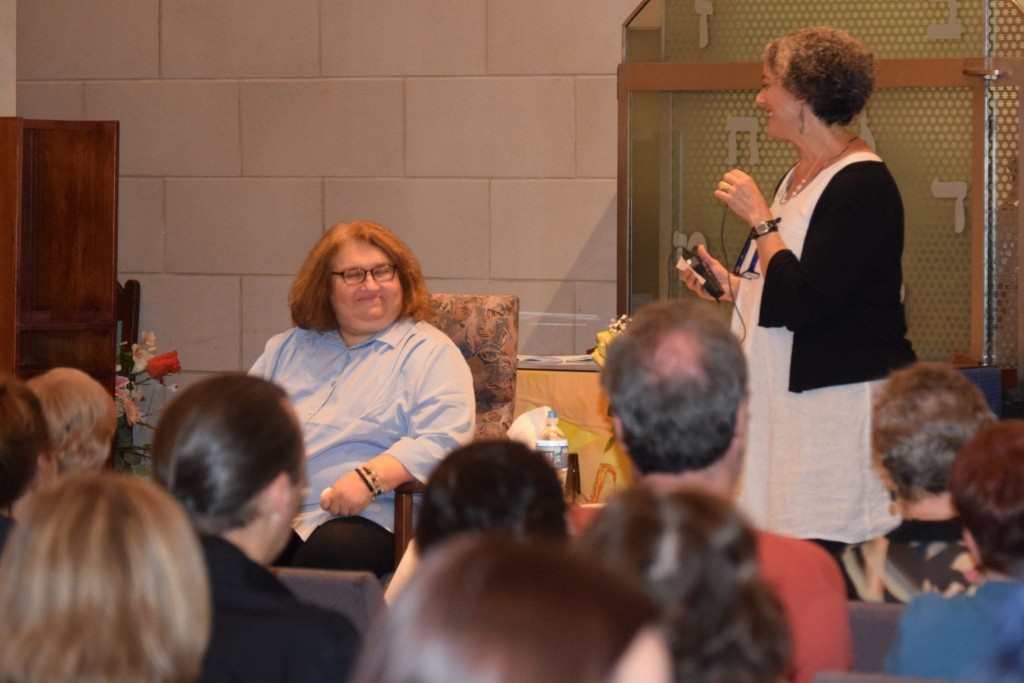
On Sept. 25, Salzberg spoke about “Real Love” to an audience of more than 200 in the Gorn Chapel at Beth El Congregation. The program was presented by The Alvin & Lois Lapidus Center for Healing & Spirituality, aka The Soul Center, which is located on the Pikesville synagogue’s campus.
An author of 10 books, Salzberg, 65, said “Real Love” is the culmination of her “lifetime exploration of love.” But she said the impetus for writing “this particular book” came from a line she heard in the 2007 movie “Dan in Real Life”: “Love is not a feeling, it’s an ability.”
The line resonated deeply with Salzberg, who felt it described perfectly what she had discovered through loving-kindness meditation, a technique that cultivates compassion for the self and others. Salzberg has practiced loving-kindness meditation since the mid-1980s.
“Real Love” promotes a sense of “connection … to ourselves, to others and to life itself,” said Salzberg, who is co-founder of the Insight Meditation Society in Barre, Mass. “It’s a feeling of belonging and understanding. It’s that moment you feel you’re really seeing someone and they’re really seeing you.”
In loving-kindness meditation, Salzberg writes in “Real Love,” the practitioner “offers loving-kindness to [him or herself] and then moves on to others with whom they have varying degrees of difficulty. After ourselves, over time we will meditate on someone we admire and respect, then a friend, then a neutral person such as your dry cleaner or a shopkeeper, then a person who is somewhat challenging for you, and then all beings.” During meditation, one may concentrate on phrases such as “May I be safe,” “Be happy,” “Be healthy” or “Live with ease,” Salzberg wrote.
Before her discovery of loving-kindness meditation, Salzberg told the Soul Center audience that she “had always thought of love as something outside of myself that someone could give me like a package, and someone could take it away leaving me bereft and without love.”
Salzberg said her experiences with loving-kindness meditation led to her realization that “love was a capacity inside myself. That was empowering,” she said.
Described by the book’s publisher as a “creative tool kit of mindfulness exercises and meditation techniques,” “Real Love” offers Salzberg’s personal reflections and stories from her friends, colleagues and students about their spiritual strivings. The book is divided into three sections designed to help readers attain authentic self-love, love for others and love for all beings.
Salzberg acknowledged that attaining real love isn’t always easy. For example, she said, the concept of self-love can be challenging.
“We often think of self-love as selfish or narcissistic,” she said. “But it’s not selfish. Research is starting to show that self-compassion is the best way to make change in your life. … When we build a reservoir with self-care, we have more to give [to others].”
To experience authentic love for others, Salzberg advised readers to “slough off some limiting notions of love perpetuated by our culture.”
For instance, Salzberg charges that many people are acculturated to believe that romantic love isn’t real unless it causes pain and suffering, or that they are only whole when a partner completes them.
Instead, Salzberg writes that people must be willing “to unpack our assumptions” about others, about what it means to love them, and arguably, hardest of all, to be vulnerable with them.
Perhaps most challenging is the goal of loving all beings, from the most casual acquaintances to strangers to those who commit hateful acts. At the Soul Center gathering, audience members asked Salzberg about how to love people such as the white supremacists who marched in Charlottesville, Va., over the summer.
“It’s never going to be easy,” admitted Salzberg. “But love is not defined by liking or approving of what someone does. … Instead, try to understand their mind-state, try not to objectify others, try to find their humanity and not perpetuate their hatefulness. …
“Sometimes we fall into a trap where we think there’s only one way to be loving,” she said. “Love doesn’t mean being a pushover. Consider the civil rights movement. It was all about love, but it didn’t stop Martin Luther King Jr.’s strength.”
Another audience member asked, “Is it enough just to be kind?”
Salzberg responded, “I think it’s extremely powerful if our motivation is kindness. I believe it’s extremely powerful to take actions even if you can’t make all the suffering in the world disappear. … So many times, we plant a seed [and] there’s not necessarily a result right away, but that doesn’t mean there’s not a result.”
For information about The Soul Center, visit soulcenterbaltimore.org.
Photo by Judi Snyder

Jewish Community Services' upcoming "Future-Ready Workplace" event will feature a keynote address from workplace expert and bestselling author Liz Fosslien.
The BCO, founded in 1984, will perform the works of Frank Zappa, Beethoven, Mason Bates and Karena Ingram.

Led by local Israel-American cellist Amit Peled, the Mount Vernon Virtuosi aims to inspire people beyond musical enjoyment.

Container vegetable gardening is a terrific option for people with limited space and/or time. Rebecca Brown and Norman Cohen share some tips.