
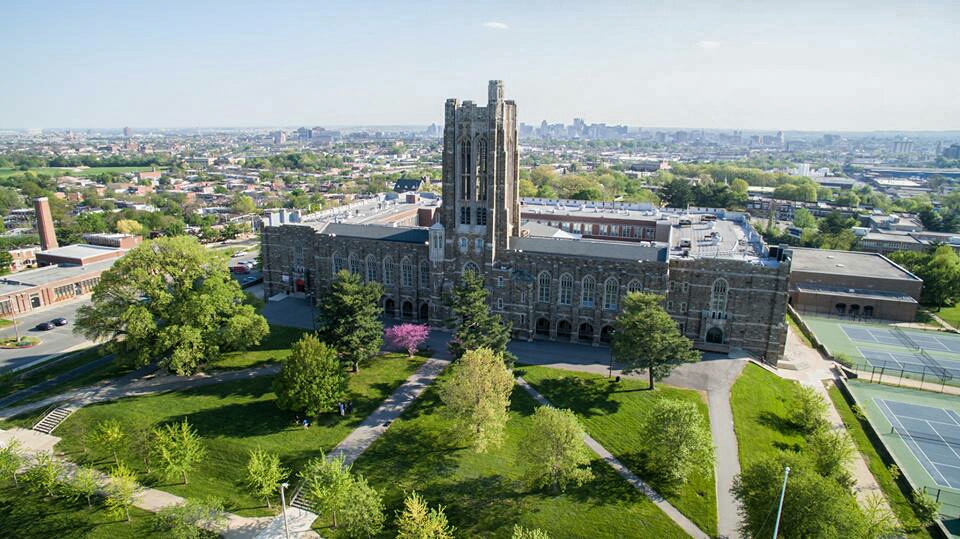
The old man’s name was Henry Yost. He stood there with his rheumy voice and what must’ve been the last high-collared dress shirt in all of North America, and told us we were now part of a marvelous legacy.
“Gentlemen,” said this esteemed school principal, “you have passed your first intelligence test by choosing Baltimore City College as your high school.”
There were more than 700 of us sitting in City’s auditorium that morning, adolescent boys trying to hide our anxieties on our first day of high school precisely 60 years ago.
I’m saddened for all those kids cheated out of the complete education experience this year because of the coronavirus plague. Their loss is a reminder of the richness of normal school years, particularly for those in public schools, with their inclusive American mix.
“The future mayor of Baltimore is sitting in this room right now,” Yost told us that autumn morning in 1960. “That is the City College history.”
I was sitting next to my friend Stanley Nusenko, who turned and whispered in my ear, “He ain’t talkin’ about me.”
The notion of political greatness was inconceivable for any of us at age 15.
In that moment, we didn’t know that a future U.S. congressman, Dutch Ruppersberger, sat among us. And that a future U.S. senator, Ben Cardin, had only recently preceded us here. And that a future U.S. congressman, Elijah Cummings, and a future mayor of Baltimore, Kurt L. Schmoke, were right behind us.
Back then, who knew?
As we walked through City’s crowded hallways in the coming days, nobody talked about future mayors. Sometimes we’d notice upperclassmen looking at us disdainfully and muttering a phrase: “K-Ds.”
It was shorthand for “knuckle-draggers.” They were comparing us, with some justification, to cave dwellers.
Sometimes the phrase fit. There was a 10th-grade geometry teacher named Luther Dittman who strode across the front of his classroom each afternoon, gradebook in hand, and gave oral pop quizzes. Get it right, you got an A; get it wrong, you took a zero. One day he called on a classmate named Brooks, the toughest kid in the room.
“Brooks,” said Dittman, pointing to the blackboard, “what about the opposite angles of a parallelogram?”
In a growl that seemed to come up from his sneakers, Brooks answered, “Well, what about ‘em?”
It was the cry of the reluctant, declaring, “We dare you to try to teach us something.” But it was also the fault line of every first-rate school: There are choices to make here, which will affect you for the rest of your lives. Pay attention, or pay the price.
It’s a source of delight that City College thrives these days. Well over 90 percent of its graduates go on to college.
But it’s a source of sadness that so few public high schools in the city of Baltimore offer such richness. There’s Poly, there’s Western, there’s the School for the Arts — and that’s about it.
It’s also sad that so many families choose to avoid the public schools completely. I’m reminded of Eric Sevareid’s “Not So Wild a Dream,” the late CBS news commentator’s wonderful post-war autobiography.
In the “complete, leveling atmosphere of the public school,” Sevareid wrote, a student becomes “almost oblivious of social classes. … He acquires more respect for brain than for birth. … He learns the doing of things together as the natural method, and since the central problem of our times is the social problem, the instinct of working together is the most important instinct a man can learn.
“Intellectuals go through a phase when ‘the team spirit’ is a joke. Later I saw it win a war for my country.”
For me, the great mix of race and religion and social class personified the richest gift of public schools. The future mayors were there, and so were the “K-Ds.” It was everyone’s introduction to our grand diversity.
It’s one more thing the kids are missing this year, as they sit in their isolation, far from friends, far from the American mix.
A former Baltimore Sun columnist and WJZ-TV commentator, Michael Olesker is the author of six books. His most recent, “Front Stoops in the Fifties: Baltimore Legends Come of Age,” was reissued in paperback by the Johns Hopkins University Press.

A new biography on the creator of "Doonesbury" misses the mark, writes Michael Olesker.
What does it mean to be fully present with each other and the sacred, asks Maryland-born cultural anthropologist Alanna E. Cooper.
As millions mourn the passing of Stephen Colbert from the airwaves, Michael Olesker looks back on the "institution" of late-night TV.

As he gets ready to leave for California, Rabbi Daniel Cotzin Burg looks back on his time in Baltimore and his 10 years writing for Jmore.