
When I reached Mercy Medical Center for my first COVID shot the other day, I got into a line of about 75 people looking like survivors trying to climb into lifeboats before the ship of state goes under.
The latest count has more than 26 million COVID cases across America, including more than 441,000 people who have died. In Maryland, the death toll is roughly 7,000 among more than 350,000 reported cases.
And that’s only part of the tragedy, as witnessed in the frigid morning air just outside of Mercy.
The good news is that roughly 4.5 million Americans have now been fully vaccinated. The bad news is almost everything else, computed in fallout numbers from the virus: 30 million Americans who say they don’t have enough food, millions who have lost their jobs, millions more who can’t pay their rent, and the uncountable homeless, most of whom were homeless before the virus and will remain so afterwards.
Including those freezing outside of Mercy.
Inside the hospital, things moved along nicely. I had a 9:30 appointment and got there at 9:15. The line looked pretty imposing, but it moved along nicely.
We hear reports out of other states that sound staggering: old people who have to stand in line for hours at a time to get vaccinated. Or those who have to travel long distances – I’m thinking about an ex-wife of mine in Florida now who had to drive with her husband for nearly two hours to get her first vaccination, and then had to wait in their car for another 90 minutes before making the two-hour drive back home.
At Mercy, they sat me down for my shot at precisely 9:30, right on schedule. Once vaccinated, everyone sits for 15 minutes to make certain they’re not suffering any immediate side effects.
It’s a moment, also, to consider how lucky we are to have brilliant scientists creating a vaccine, and politicians who actually pay attention, and places like Mercy to give us hope of beating this disease.
I was out the door and back onto St. Paul Street at 9:45.
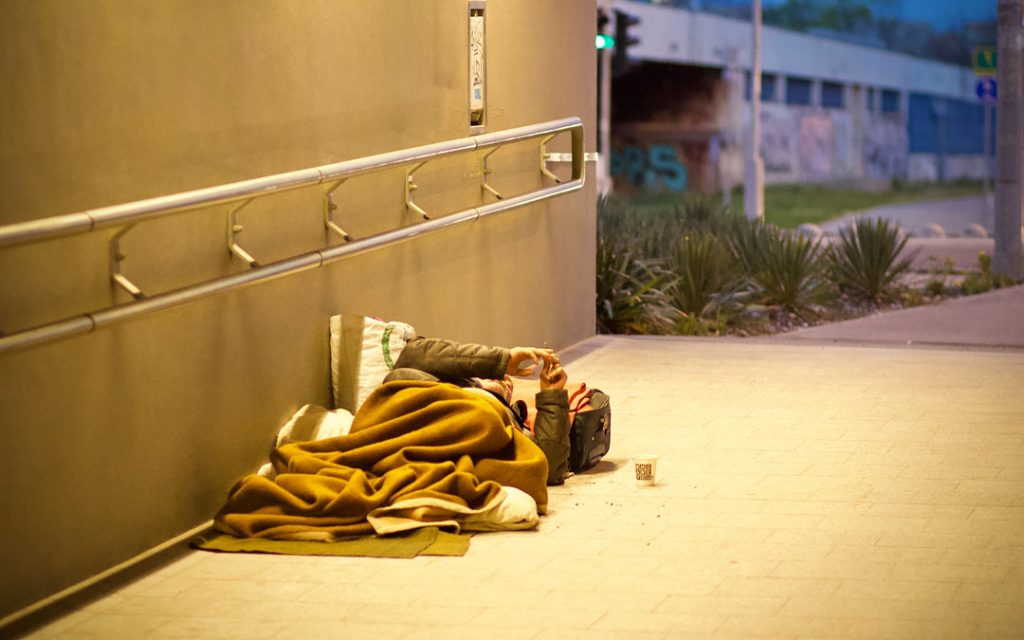
The temperature on the street was 28 degrees, and the wind against my neck felt like a hatchet coming down. The two homeless lumps on the sidewalk, maybe 20 feet apart, lay beneath a bridge. The cold and wind would get them, but if rain or snow arrived, at least they’d be dry.
Each of these homeless people was covered in layers of old blankets. We’ve got plenty of people – far too many – like this in the Baltimore area, but we really don’t know how many.
Last week, in a lengthy editorial, the New York Times said the government estimates more than half a million homeless across the United States. But the number is debatable since school districts across the country estimate 1.35 million homeless students.
As the Times declared, “The number of people who are homeless during the course of a year is significantly larger than the number on any given night. … [But head counts] typically conducted late at night include only people who are found in places not meant for human habitation, including public shelters, cars and doorways.
“It does not count people who have found temporary shelter in hotel rooms or campgrounds or in a friend’s living room. The difference is large, particularly for a count that is generally conducted on one of the coldest days of the year, when people might be especially prone to find shelter if they can.”
The homeless were there before the pandemic, and they’ll be there whenever this plague finally ends.
Who knows when those two human beings buried barely alive beneath their blankets, half a block from Mercy Hospital, got there.
Inside the hospital, we were lucky. We’re all nervous about the COVID virus. We’ve all read the awful statistics. But we all had homes to go to, where the temperature’s pretty comfortable.
Those two souls on St. Paul Street were out there as the temperature dipped into the teens. They might have been there over the weekend as snow began to fall. They’ll probably be out there tonight, and the night after.
A former Baltimore Sun columnist and WJZ-TV commentator, Michael Olesker is the author of six books. His most recent, “Front Stoops in the Fifties: Baltimore Legends Come of Age,” was reissued in paperback by the Johns Hopkins University Press.

A new biography on the creator of "Doonesbury" misses the mark, writes Michael Olesker.
What does it mean to be fully present with each other and the sacred, asks Maryland-born cultural anthropologist Alanna E. Cooper.
As millions mourn the passing of Stephen Colbert from the airwaves, Michael Olesker looks back on the "institution" of late-night TV.
As he gets ready to leave for California, Rabbi Daniel Cotzin Burg looks back on his time in Baltimore and his 10 years writing for Jmore.