
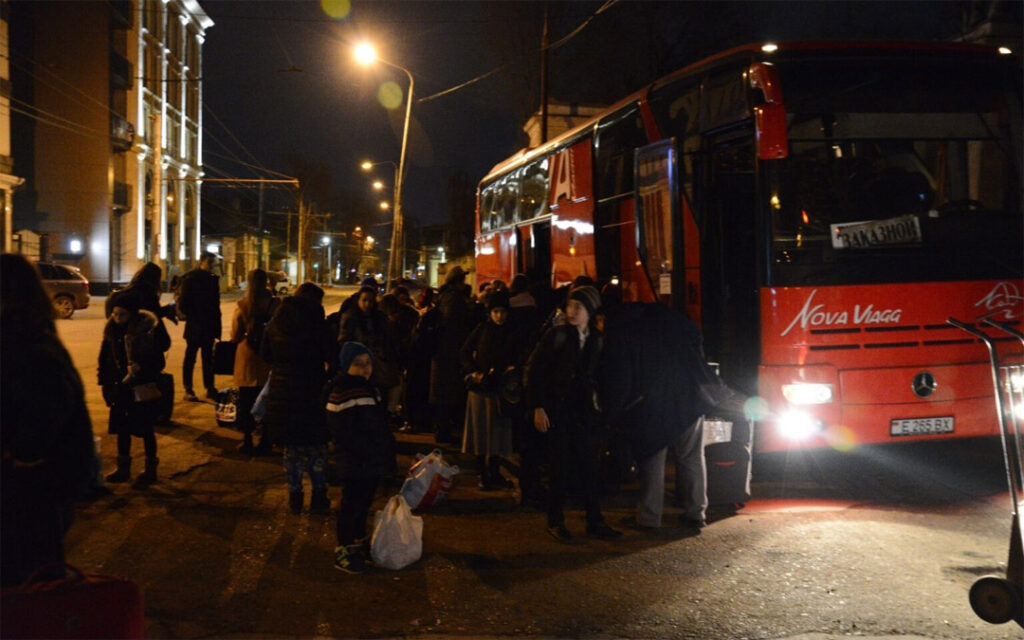
Early in May of 1901, the 30-year old Izak Lobman packed his bag, bid a temporary farewell to his wife, Elsie, and his two sons, Moses and Avrum, and left the shtetl called Bolekhov, located now in embattled Ukraine.
Izak was my great-grandfather. He boarded a train to Amsterdam and then took the S.S. Rotterdam to America. The sailing took 12 days. According to Transcription of Entry records, he arrived with $6 in his pockets. He was 5-feet-2, weighed 130 pound and spoke no English.
Izak found a room on the Lower East Side of Manhattan, where he became somebody called William Loebman. He found work as a waiter, and eventually became an insurance agent.
It took nearly four years for him to raise enough money to bring Elsie and the two boys here. But they made up for lost time. They had more children, including a future doctor, a merchant seaman, a U.S. postal worker, a stenographer, a shoe store owner. And these children had kids of their own, including another doctor, a teacher, a school administrator.
So that’s my family connection to Ukraine. And maybe I’m not the only one following the televised slaughter there from the comfort of my living room and thinking about roads taken — and not taken.
Bolekhov, the shtetl where Izak Lobman grew up, is sometimes spelled differently. It depends upon who’s doing the spelling, and which country claims authority over it. It’s located near the Carpathian Mountains, in what is now western Ukraine, but at various times, it’s been Polish, Austrian, Hungarian, Lithuanian and Russian. It all depends on who won the most recent war. There have been lots of them across the years.
For the past 30 years, Ukraine dares to be independent — but not for long, not if Russia’s Vladimir Putin continues with this madness of his.
On television now, I watch this ancient, shriveled Ukrainian woman, fighting for her spot in a Kyiv train station crammed with desperate people, and I think, that might have been my own grandparent, had Izak not come here in his own desperation.
And millions of us can watch the coverage of Ukrainian children learning to use puny rifles in hopes of fending off the Russian tanks, and think, these could have been our cousins.
And millions more of us hear the latest recitation of raw casualty numbers and wonder, might that have been me, if someone long ago hadn’t made the journey to America?
This war is personal.
Those pictures on our TV screens now look like leftovers from old World War II footage. Soon, it’ll be scenes of street-to-street, or hand-to-hand coverage.
But as Tom Friedman writes, in the New York Times, “This is not 1945. We may be back in the jungle. But today the jungle is wired. It is wired together more intimately than ever before by telecommunications; satellites; trade; the internet; road, rail and air networks; financial markets and supply chains …
“As this war unfolds on TikTok, Facebook, YouTube and Twitter, Putin cannot closet his Russian population — let alone the rest of the world — from the horrific images that will come out of this war as it enters its urban phase.”
We’re all connected now, through the miracles of modern technology.
Also, through our own family histories.
When Izak Lobman left Bolekhov in 1901, he had no idea what the murderous new century would bring.
In 1941, German police rounded up a thousand of Bolekhov’s Jewish leaders and shot them in a nearby forest. A year later, another 1,500 of the shtetel’s Jews were systematically murdered. Half of them were children. Then, 2,000 more Jews were sent to a death camp. In 1943, nearly a thousand were marched to a nearby cemetery and shot.
Only a few dozen of Bolekhov’s Jews survived the war.
In fact, Ukraine has a history of anti-Semitism. But, as historians have pointed out, past persecution was carried out when Ukraine’s territory was under the control of foreign states, principally Russia and Germany, which made anti-Semitism official policy.
Today, independent Ukraine’s president and prime minister are Jewish. Yet Putin refers to them as “Nazis.”
At such a moment, when truth has so little meaning, and human life so little currency, it’s useful to recall family histories — wherever we come from, whatever our faith — and thank those who first made the treacherous journey here.
Michael Olesker’s newest book, “Boogie: Life on A Merry-Go-Round,” will be published this spring. It’s the life story of Baltimore legend Leonard “Boogie” Weinglass,an original “Diner” guy who grew up to create the Merry-Go-Round clothing chain and donate millions to charity.

A new biography on the creator of "Doonesbury" misses the mark, writes Michael Olesker.
What does it mean to be fully present with each other and the sacred, asks Maryland-born cultural anthropologist Alanna E. Cooper.
As millions mourn the passing of Stephen Colbert from the airwaves, Michael Olesker looks back on the "institution" of late-night TV.

As he gets ready to leave for California, Rabbi Daniel Cotzin Burg looks back on his time in Baltimore and his 10 years writing for Jmore.