
Not long ago, my family and I were staying at a hotel in Southern California. I went to retrieve my rental car from the underground parking lot. As I approached the vehicle, I noticed a custodial employee methodically wiping down the exterior of a trash can.
I found myself staring at the man for a long minute wondering what motivated him to pay such attention to detail. At first, I discovered myself dismissing the behavior as absurd — why would anyone bother to clean a garbage can? In a garage? Maybe his boss was overly fastidious? Or petty? Maybe the expectations for trash can cleanliness are different in California than in Maryland?
But as I watched him, my thinking softened. Maybe he simply took pride in his work? Maybe he walked away from that trash can with a sense of fulfillment, knowing that before clocking out, when he scanned that garage with his gaze, every corner looked unsullied and tidy?
So often we evaluate behavior, of ourselves and others, based on whether it’s good or bad. Jewish tradition certainly offers moral judgments; God is a God of justice. But this is not the only lens through which to view the world. Often,
a better question to ask ourselves isn’t whether some human act is right or wrong but whether it adds value, whether it moves someone toward a life of greater fulfillment.
In his book “Everyday Holiness” (Trumpeter), Alan Morinis cites Rabbi Moshe Chaim Luzzatto, a seminal voice in the modern Mussar movement. Writes Morinis: “… Luzzatto tells us that as humans we are all placed between wholeness and deficiency with the power to earn wholeness. Man must earn this wholeness, however, through his own free will.”
It seems to me that religions too often talk about how we move on a spectrum between evil and goodness, wrong and right. This is useful in addressing ethical questions but falls short when addressing quality of life.
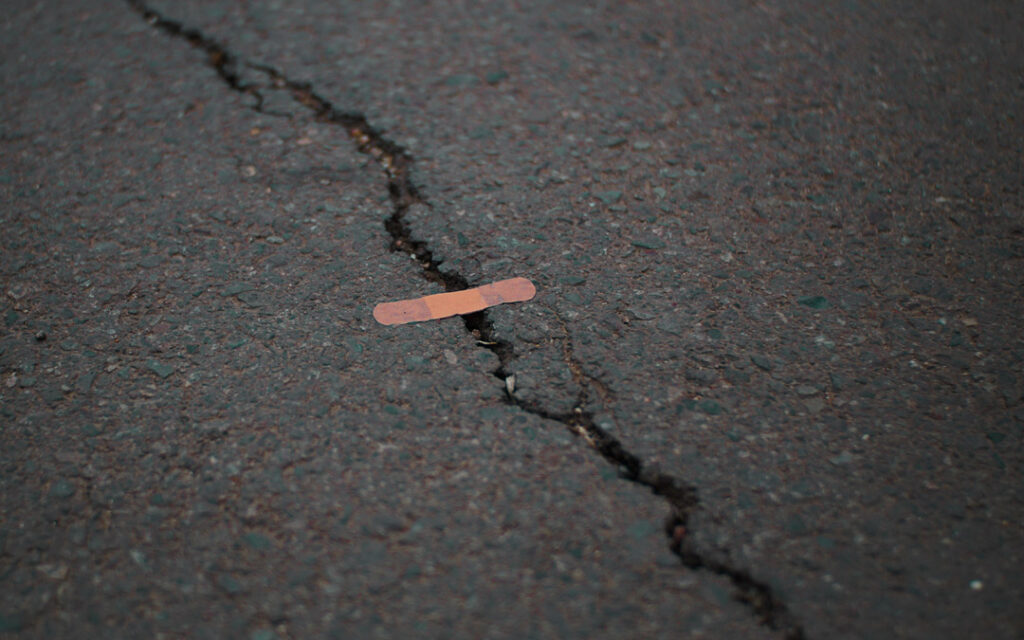
Another paradigm is that of brokenness and repair. This paradigm also has its merits, but its shortcomings are twofold. First, the repair of something broken brings it back to a previously functional state but does nothing to advance it. Repair about reinstatement, not improvement. But there’s a more insidious problem with the brokenness/repair model. Things can be broken and fixed. They don’t notice they are broken. They’re things.
People who feel broken (or, frequently, who are made to feel broken) struggle to mend because feeling broken is constitutionally debilitating when, as Luzzatto taught, our souls crave wholeness. The same is true for communities and societies. When people talk about Baltimore as “broken,” it does little to make Baltimoreans feels good about our prospects for improvement.
I once wrote a piece (cross-published in Jmore) about the tikkun olam paradigm, popular in Jewish justice circles but which I feel is problematic.
“The tikkun olam paradigm,” I wrote, “means human partnership with God bestows upon us a nearly impossible task: to fashion wholeness from brokenness. We are less partners with God as we are entropy janitors, cleaning up a profound cosmic mess. Bereishit (Genesis), though, seems to understand creation as a process. The universe is unfurling before humanity. The world isn’t broken. It’s incomplete, unrealized.”
This is why Rabbi Luzzatto’s paradigm of deficiency and wholeness is useful. Maybe the California custodian who meticulously wiped down that trash can isn’t an “entropy janitor” but on a quest for sheleimut, wholeness and fulfillment. Maybe more of us would thrive if we could see ourselves on a path forward and upward instead of feeling broken or breaking and in constant need of repair.
Baltimore has endemic problems to be sure, but ours is not a “problematic” city. If only more would look at our city with at least the same sense of pride as I witnessed one day in a California garage.
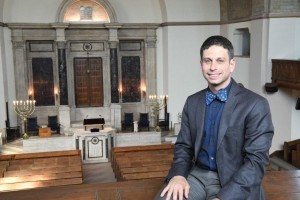
Rabbi Daniel Cotzin Burg is spiritual leader of Beth Am Synagogue in Reservoir Hill, where he lives with his wife, Rabbi Miriam Cotzin Burg, and their children, Eliyah and Shamir. This column and others also can be found on The Urban Rabbi. Each month in Jmore, Rabbi Burg explores a different facet of The New Jewish Neighborhood, a place where Jewish community is reclaimed and Jewish values reimagined in Baltimore.

A new biography on the creator of "Doonesbury" misses the mark, writes Michael Olesker.
What does it mean to be fully present with each other and the sacred, asks Maryland-born cultural anthropologist Alanna E. Cooper.
As millions mourn the passing of Stephen Colbert from the airwaves, Michael Olesker looks back on the "institution" of late-night TV.

As he gets ready to leave for California, Rabbi Daniel Cotzin Burg looks back on his time in Baltimore and his 10 years writing for Jmore.