Intellectually, I’ve always known it could happen.
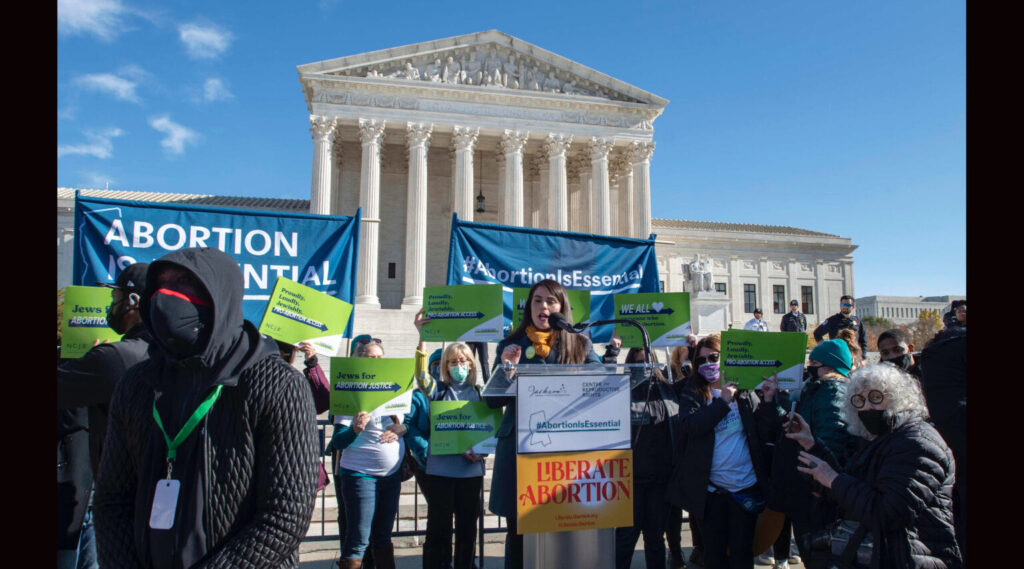
In the fall of 2021, I signed onto an amicus brief with nearly 900 state legislators from across the nation to protect the constitutional right to an abortion in Dobbs v. Jackson Women’s Health, a case before the U.S. Supreme Court seeking to ban pre-viability abortions.
I even wrote in an email blast sent a few months ago: I fear that this Supreme Court is going to overturn years of precedent, severely restricting the right to obtain an abortion.
I should have been prepared when reading this winter about the severe restrictions the Texas legislature placed on the ability to get an abortion using an ingenious and diabolical approach that makes anyone assisting in the termination of a pregnancy a criminal. That should have been the wake-up call.
But I didn’t realize that seeing a draft decision of the Dobbs case in print (released by Politico on May 2), throwing out nearly 50 years of precedent would give me the kick-in-the-gut emotional response that I felt. Justice Samuel Alito’s draft decision would overturn Roe v Wade, the seminal case granting a constitutionally protected right to an abortion.
It’s a draft and it’s not uncommon for there to be changes before final decisions are issued. But still …
The Supreme Court has made significant changes to rulings it’s made in the past regarding important civil rights issues, for example, yet no one can recall a time when the justices have done so in a way that restricts a right rather than expands a right.
Think of access to contraception, voting rights, or marriage equality — these were all decisions that expanded fundamental rights. The draft Dobbs decision makes the right to an abortion no longer a constitutional right to be protected by the federal government; it enables states to enact virtually whatever restrictions they desire. Thirteen states have trigger laws that will automatically ban abortion if the Supreme Court overturns Roe, and 10 more are anticipated to severely restrict access.
We’ve long known that the right to be able to choose among the fullest array of reproductive health care choices has been precarious. But for me, the choice about when I wanted to have children has always been there. I came of age at a time when the hard-fought struggles to provide access to abortion and enshrine them in the rule of law were settled by women and men who fought righteously so that I and millions of others wouldn’t have to.
The reality is that for people who have resources and who have privilege, the ability to access abortion, even if there is no constitutional protection to have one, will still remain. History has demonstrated that while it may be difficult, delayed and diminished, people who have resources and want to get abortions still will.
It’s the people who already struggle with limited access to health care who will suffer: those who are low-income, Black, Latino or live in rural areas.
The need and desire to have an abortion will not disappear, rather it will go underground in certain states. We’ll return to a time when there will be an underground railroad of sorts, like the Jane Collective, a group founded by some Jewish women (and others) who would help women get abortions in Chicago in the late 1960s.
Only now, the threat of laws, like Texas’, will loom, having the potential to reach into even those states where abortion is legal. No doubt, the tentacles of those criminal penalties reaching into other states will be tested, but I have zero faith that this Supreme Court will offer protection.
The underlying logic of Roe and Planned Parenthood v Casey, decided in 1992 (that upheld Roe), is rooted in the 14th amendment of the Constitution that protects individuals’ liberty to make certain decisions, including the right to have an abortion.
Justice Alito’s draft rejects the grounding of these constitutional protections. And while the decision articulates its intention to focus only on abortion, it’s virtually impossible not to also be concerned about other constitutional protections similarly grounded in the same 14th amendment liberty clause: access to contraception and the right to same sex marriage among them.
Elections have consequences. If that point has not been driven home by the release of this draft opinion, I don’t know what will. Donald Trump could not have been clearer in his intention to appoint justices to the Supreme Court that would overturn Roe. Sen. Mitch McConnell’s blocking of President Obama’s nomination of Merrick Garland to the Supreme Court following the death of Justice Antonin Scalia set the table for today’s court make-up and enabled President Trump to have three appointments, confirmed by a Republican Senate.
Here in Maryland, public support for access to abortion is strong. According to a 2021 poll, 72% of Marylanders oppose overturning Roe and 79% support ensuring individuals have access to the full range of reproductive health care services. I’m proud that the General Assembly enacted, over Governor Hogan’s veto, the Abortion Care Access Act that will expand and make safer access to abortion. We’ll train licensed medical health professionals to provide abortion care, like nurse practitioners and nurse midwives, who are already experienced pregnancy caregivers, and we’ll make sure that private and public insurance cover costs. We set aside $3.5 million to begin this training program, but Governor Hogan, who has the power to release these funds now, has refused. We’ll keep pressing him to release the funds — all the more urgent if the Supreme Court overturns Roe.
As if recent news wasn’t bleak enough, imagine what could happen if Republicans gain control of the House and Senate and if Donald Trump were re-elected president. The possibility of Congress passing a law banning abortion outright is not my imagination running wild.
I’m regularly asked what can be done and I keep coming back to the same response: vote and make sure others do. We have the clearest indication yet of the direction of this Supreme Court.

What’s the antidote? Congressional action. Congress could enact the Women’s Health Protection Act that would protect the right to abortion. Electing a solidly pro-choice Congress may take some time, so it’s also critical to support pro-choice state legislators and community services that will enable people to get the broadest possible reproductive health care services they need and deserve. If there was ever a time to vote like your life depended on it, it’s now, because yours and millions of others could.
Shelly L. Hettleman is a Democratic member of the Maryland Senate representing District 11.

What does it mean to be fully present with each other and the sacred, asks Maryland-born cultural anthropologist Alanna E. Cooper.

As millions mourn the passing of Stephen Colbert from the airwaves, Michael Olesker looks back on the "institution" of late-night TV.

As he gets ready to leave for California, Rabbi Daniel Cotzin Burg looks back on his time in Baltimore and his 10 years writing for Jmore.