The Talmud (Arakhin 15b) discusses the problem of lashon hara (wicked or destructive speech): “Rabbi Hama, son of Rabbi Hanina, says: What is the meaning of that which is written: ‘Death and life are in the hand of the tongue’ (Proverbs 18:21). [It teaches that] just as a hand can kill, so too a tongue can kill. If you were to claim that just as the hand kills only from close by, so too the tongue kills only from close by, therefore the verse states: ‘Their tongue is a sharpened arrow’ (Jeremiah 9:7).”
The text is hyperbolic, but it’s meant to drive home an important point: words matter. When we say or write things, people hear or read them. They internalize them. Often they share them, retweet them or teach them to their children.
Why does the Talmud make a point of saying words can harm like arrows? Because arrows can be fired from a distance. As can words.
In the March/April issue of this publication, there appeared an article (“The Wonders of Whitelock Street”) by Steve Liebowitz, who is described as a “Baltimore-based freelance writer and author.” I do not know Mr. Liebowitz but since he was writing “from a distance,” I’d like to take this opportunity to correct a few things about the neighborhood where I live and work, just in case people were reading his words and taking them to heart.
“The next time you’re in Reservoir Hill,” he begins, “take notice of a barren stretch of curved road between Linden and Brookfield avenues known as Whitelock Street.” This sentence provides cover for the author to describe the good ole’ days when Jewish merchants and shopkeepers sold kosher meats and baked goods.
By the end of the piece, Mr. Liebowitz grudgingly acknowledges what is now a “verdant area of parks and the Whitelock Community Farm, where residents grown their own vegetables.” But then he takes those residents to task for not knowing that “the land they are using for healthy eating today once brimmed with Jewish grocery stores and merchants.”
I’m not sure which is worse: the blatant assumption of widespread ignorance about our community’s past or the implication that striving to grow carrots or kale in a food desert is categorically inferior to pastrami on rye. Mr. Liebowitz romanticizes the Jewish past, alternates between denigrating and pitying the African American community that moved in, and virtually ignores the neighborhood as it is today.
Look closely at the piece and you’ll find language used to describe Jewish departure from the neighborhood as an “exodus.” An exodus was what our ancestors did when they fled slavery in Egypt. The word “flight” better describes what happened in the 1950s and ‘60s when Jews participated in a mass migration from Baltimore’s urban center toward the county. And notice the words he uses to describe what was left behind: “As Jewish residents gradually moved away … African-Americans [sic] moved into the neighborhood.” And elsewhere he depicts an “open drug market besotted with violence.”
What Mr. Liebowitz does not mention is that most Jewish residents did not move away gradually. He doesn’t site policies like red-lining and practices like blockbusting that were employed to transition neighborhoods like mine quickly, and line the pockets of speculators and banks who overcharged incoming Black residents even as Jim Crow-era racist policies drained resources from West Baltimore.
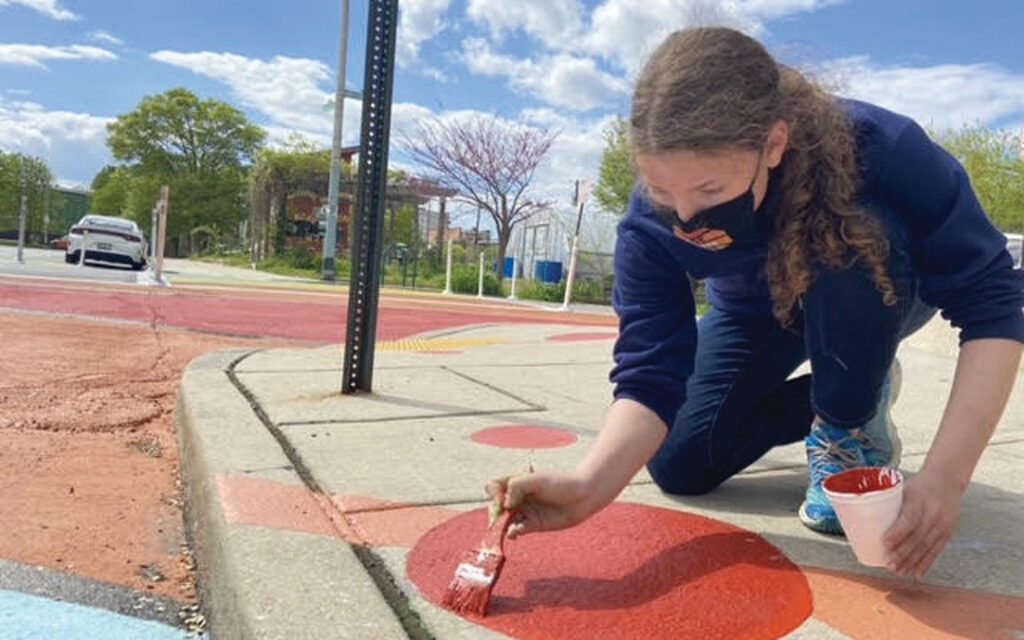
Perhaps worst of all, while celebrating Reservoir Hill’s Jewish past, Mr. Liebowitz completely ignores its Jewish present. That stretch of road between Linden and Brookfield is not just where Wasserman & Lemberger’s once stood, it’s also where Beth Am Synagogue’s sukkah stood the past two years while our offices and courtyard were awaiting construction. Linden and Whitelock is where 300-plus volunteers came together to build a new playground in 2011, and where Beth Am has held young family services and kiddush luncheons during the pandemic.
Whitelock Street is where a Beth Am member helps to coordinate a long-standing community garden, and where the St. Francis Neighborhood Center has completed a major expansion to better serve Reservoir Hill youth. And Whitelock Street (on precisely the lot where Surosky’s Butcher once stood) is where Beth Am will sponsor the Children’s Village of the Reservoir Hill Juneteenth celebration this summer.
Perhaps Mr. Liebowitz would like to stop by and write about that.
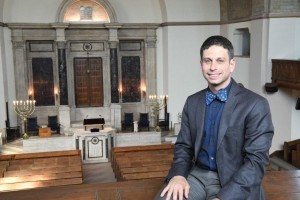
Rabbi Daniel Cotzin Burg is spiritual leader of Beth Am Synagogue in Reservoir Hill, where he lives with his wife, Rabbi Miriam Cotzin Burg, and their children, Eliyah and Shamir. This column and others also can be found on The Urban Rabbi. Each month in Jmore, Rabbi Burg explores a different facet of The New Jewish Neighborhood, a place where Jewish community is reclaimed and Jewish values reimagined in Baltimore.
What does it mean to be fully present with each other and the sacred, asks Maryland-born cultural anthropologist Alanna E. Cooper.
As millions mourn the passing of Stephen Colbert from the airwaves, Michael Olesker looks back on the "institution" of late-night TV.

As he gets ready to leave for California, Rabbi Daniel Cotzin Burg looks back on his time in Baltimore and his 10 years writing for Jmore.