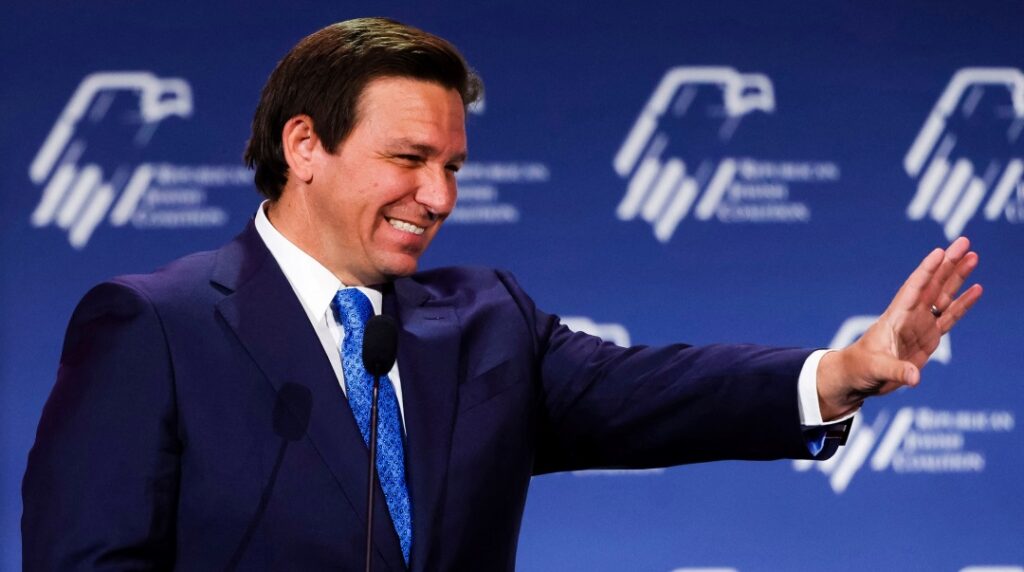
In his quest to become the next president of the United States, Gov. Ron DeSantis (R-Florida) hopes to change history by eliminating it from all memory.
With his Stop WOKE Act, he wants to ban a bunch of books. He says they’ll make certain people — white people, mainly — uncomfortable if they read the truth about American history. He offers this book banning as a kind of “protection” for delicate readers.
Last April, DeSantis signed his Stop WOKE Act, which bans in-school discussions about racism, LGBTQ+ issues, economic inequity and oppression. Books that haven’t been officially vetted and approved must be hidden.
Then things got worse.
Earlier this month, the College Board — after heavy criticism from DeSantis and other conservatives — announced revisions of its newly created Advanced Placement course in African-American Studies. The board wants to cut discussion of Black Lives Matter, police brutality, mass incarceration, queer Black life, Black feminism, and the Black Power movement of the 1960s and ‘70s.
They want to protect delicate brains from thinking about America’s indelicate past.
Careful, folks, it’s not the first time we’ve heard this argument around here. The difference is, the censorship issue was made around here by school administrators whose instinct really was “protective,” and not political like DeSantis.
But either way, this notion of censoring books is a misguided attempt to bury the truth. And though it starts this time in Florida, they may start aiming at a library or a school closer to home.
What comes to my mind is Owings Mills High School in 1999, as we welcomed in what we imagined would be the enlightened 21st century.

Some enlightenment.
Back then, the principal at Owings Mills High wanted to scrap a theatrical production “To Kill A Mockingbird,” Harper Lee’s 1960 literary classic about a white Southern lawyer who defends a Black man wrongly accused of raping a white girl.
At that time, Owings Mills High was not only racially integrated but included students from three dozen nationalities. The misguided principal felt certain words from “Mockingbird” were offensive.
She took a work of literature and reduced it to a curse.
The students at Owings Mills felt differently. Those who read the book were so moved, they wanted to perform a stage version.
They understood something their principal forgot about, and Ron DeSantis should know about but doesn’t care — that America contains all kinds of people, from all kinds of backgrounds, and here is where we work out our differences until, hopefully, enlightenment comes.
How will the new censorship work itself out? Here are two possibilities:
1. Young people will hear there are things grown-ups are trying to hide from them, and therefore figure there’s something really juicy here. And they’ll reach for it ever more fervently.
2. Or dim-witted authority figures around the country will think, “Why don’t we try that censorship stuff here?”
We’ve seen it around Baltimore before. Some misguided Baltimore County school administrators tried to ban a controversial book, not for political reasons but in a silly attempt to protect young readers.
The book was based on an old folk song, and it involved smoking, carousing and criminal behavior, and contained illustrations. It was called “Froggy Went A-Courtin’.”

Some county officials worried it might lead children into unhealthy pursuits, because everybody knows how frequently kids today use cigar-smoking, safe-cracking frogs as their real-life role models — even though at the book’s end, Froggy goes to jail, and the clear message is that crime doesn’t pay.
This is how far-reaching, and absurd, this book banning can get once it starts.
It’s enough to make a reader croak.
Michael Olesker’s latest book, “Boogie: Life on A Merry-Go-Round,” was recently published by Apprentice House. It’s the life story of Baltimore legend Leonard “Boogie” Weinglass, an original “Diner” guy who grew up to create the Merry-Go-Round clothing chain and contribute millions to charity.
What does it mean to be fully present with each other and the sacred, asks Maryland-born cultural anthropologist Alanna E. Cooper.
As millions mourn the passing of Stephen Colbert from the airwaves, Michael Olesker looks back on the "institution" of late-night TV.

As he gets ready to leave for California, Rabbi Daniel Cotzin Burg looks back on his time in Baltimore and his 10 years writing for Jmore.