

Camp season is officially here! Trunks are being packed, letter-writing stationery purchased, Shabbat whites bleached, and parents are feeling simultaneously bereft and relieved to have some time for themselves.
If you’re a former camper, camp parent or grandparent — or just a Jewish history buff — now is the perfect time to curl up with Sandra Fox’s “The Jews of Summer: Summer Camp and Jewish Culture in Postwar America” (Stanford University Press).
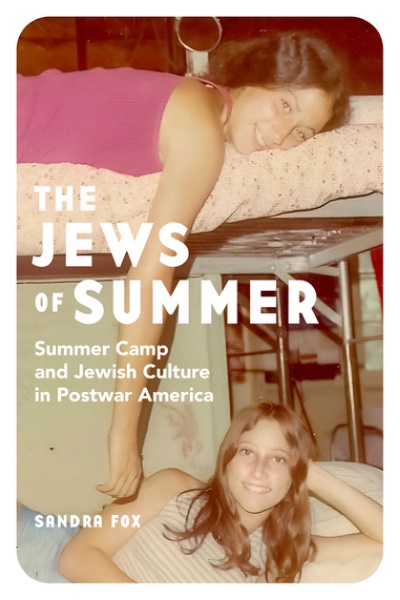
Jmore recently caught up with Fox, 34, a Brooklyn-based historian and Young Judea camp alumna. Fox is a visiting assistant professor of Hebrew Judaic studies and director of the Archive of the Jewish Left Project at New York University, and founder and executive producer of “Vaybertaytsh: A Feminist Podcast in Yiddish.”
Jmore: How would you summarize your book’s perspective?
Fox: I think my book is definitely the first to look at a wide array of educational and ideological Jewish summer camps. A lot of books have treated one particular kind of summer camp or summer camp movement as very unique. That makes a lot of sense because it’s a large undertaking to look at so many different kinds of camps.
Also, the tendency of alumni is to think of what they went through at camp as utterly unique. What I set out to do was to look at this much wider array of camps and see what was similar about them. By placing them within the history of American Jewry and American childhood and youth culture, I was able to show what broader societal or communal anxieties they were built in response to, and how they changed over time based on what kind of communal issues Jews were concerned about.
Does the book examine a particular time period?
The heart of the book is about the period right after World War II, the 1940s-1960s, essentially. But it also foregrounds that history quite a bit. With the growth of American summer camps — and American Jewish summer camps specifically — in the early 20th century when a lot of Jewish summer camps popped up for children of immigrants or immigrants themselves, a lot of them had Americanization goals. They were not as focused on maintaining Jewish culture as much as helping Jews assimilate into American culture.
Then in the mid-20th century, you have this explosion of growth of a lot of the Jewish summer camps — the Ramah camps, the Conservative and Reform movement camps. … Zionist camping predates that but also had a boom in that period. That aligns with a moment in American history where veterans are coming home from the war, and white veterans are being given scholarships and housing loans that allow them to really catapult themselves into the middle-class. That was really the case for Jews. Suddenly, they were part of the white middle-class and could utilize these benefits and move to the suburbs. All those things are super-positive.
But what a lot of scholars have found is that Jewish leaders expressed a lot of ambivalence and anxiety about this change because they didn’t understand how American Jewry would maintain a sense of authenticity under these new comfortable conditions. What is Judaism under conditions of comfort, without adversity? So these educational camps became important in a new way. They became, on the one hand, places where Jews can just come together and feel like they can express their Jewishness. … But they also become vested with solving all sorts of communal anxieties about the future of Jewish culture and religion.

What most surprised you in your research?
As I explored camps’ archives, I really did find more similarity than difference, even in camps that were ideologically opposed to one another. Yiddish camps and Zionist camps — we might think of them as polar opposites. One is promoting a sense of diaspora Jewish heritage and the other looking toward Israel for all of its answers and sense of identity. Yet, they’re all using summer camp in very similar ways.
The other thing is Yiddish camps after the Holocaust. Very few books do more than a short mention that there were summer camps imbued with Yiddish culture after 1945 or 1948. But they did exist. There’s a narrative in the Jewish community that Yiddish is going through a revival right now. But actually, if you look at the history after World War II, there was this unbroken chain of people who continued to use Yiddish as something that meant something to them culturally, even spiritually, and used Yiddish as an educational tool in a similar way American Jews use Israel as an educational tool today.
Some community leaders feel Jewish summer camps are crucial to Jewish continuity. Your thoughts?
Throughout the history of Jewish camping, especially in the period I studied and beyond, Jews have invested a lot of energy and thought and hope in the idea of summer camp as a saving grace of American Judaism. As rates of intermarriage climbed, starting in the 1960s and then revving up in the 1970s and beyond, it makes a lot of sense to look at intermarriage rates of former campers to assess success [of camps].
But I think this is maybe my point of view as a millennial. … More and more, as I see friends of mine who are Jewishly involved marry people who aren’t Jewish and still raise Jewish kids, it just feels so outdated to think that is the sign of success. What I’m interested in is how we got to those metrics of success in the first place. What was the historical process that led you to think of rates of intermarriage or supporting Israel [as] signs of where the Jewish community is? Where did those ideas come from and how did that expectation impact young Jews personally? In terms of their Jewish identities, I think it can actually lead to a lot of harm.
Why?
It can make people disengage. American Jewry is at a turning point when it comes to criticizing Israel, and maybe that’ll [change]. But Jews who don’t identify with Zionism are not really welcome in the mainstream Jewish community. One of the things I say in the book is if you look at these metrics of success — Jewish camps make kids better supporters of Israel … what about the former camper of a Zionist camp who is vehemently pro-Palestinian? Did that come out of their education at camp in some sort of indirect way? They left camp with questions. They went to Israel. They explored their identity. They explored the country. They learned about the issues. Now they might be on the other side of their camp, but it’s still related.
I don’t think that’s a failure. Once you look at it that way, you realize how politicized it is. One of the things I’m hoping my book does is allow Jewish leaders to see the diversity of ideologies that camps fostered earlier in the 20th century and how that homogenization took place. Maybe it’s time to regroup and think about a new direction for the future.

Filmmaker Justin Schein looks at wealth and inequality through the very real story of his late father.

For 35 years, the late Deborah Brodie, aka Bubbie Cookie, amassed a collection of over 200 Jewish ritual objects, which she used to teach her Hebrew school students with special needs.
Conceived by Columbia resident Benjamin Kintisch, "Life Review: The Hospice Musical" offers a thought-provoking and occasionally amusing perspective on mortality.

Steve Hofstetter, who will perform at Soundstage next week, recently made headlines for his social media post ridiculing some fans' warnings about Charm City's safety.