

“It’s a running joke in our group that most of us never expected our book to do more than sit on our coffee tables and end up one of those things our children don’t want to hang on to.”
That’s how Joy Wolfe Ensor recalls thinking about “The Ones Who Remember: Second-Generation Voices of the Holocaust.” But the book has enjoyed wide recognition, and the authors have given almost 80 presentations across the United States and abroad.
Published by City Point Press, “The Ones Who Remember” is a collection of poignant stories reframing the horrors of the Holocaust through the eyes of those affected by its aftermath.
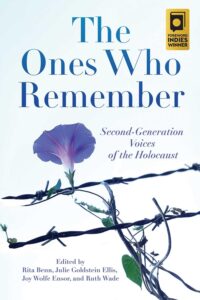
Through a bouquet of raw, well-written prose and poetry, readers are shown not only what it meant to survive a concentration camp but also what it meant for a survivor’s offspring to catch a cold or not finish all the food on their plate.
Both are horrifying in the context of being a first- and second-generation voice of the Holocaust. The book consists of 16 chapters, each written by the child of a Holocaust survivor.
Said Ensor, author of the chapter titled “One Day the World Will Be the World Again” and a member of the editing team that conceived the book in 2014: “For 10 years we had been writing original Yom HaShoah [Holocaust Remembrance Day] services, contributing our parents’ stories as a way to honor their losses, their survival and their resilience.”
When recommended by early readers to focus the narrative on their own voices rather than their parents’ experiences, Wolfe admits it was uncomfortable.
“Why would I focus on myself? This isn’t about me,” she said.
But Ensor, a psychologist who lives in Ann Arbor, Michigan, and the other co-editors took the feedback to heart.
“We agreed that if we were going to ask the other 11 living authors to take this deep-dive, we would do well to lead by example,” she says. “We encouraged each other to use the narratives that we’d contributed to services as writing prompts. To my own surprise, the words poured out of me.
“My co-editors, and later the professional developmental editor whom we engaged, asked probing questions that pushed me deeper into exploring feelings and sense memories I’d packed away for decades.”
In The Shadows
Writing each chapter was not without challenges. Rita Benn, author of the chapter “Shades of Chanel No. 5” and an editing team member who initiated the idea of the book, said, “The challenge for me in writing was to weave these stories into an integrated whole that gave a coherent snapshot of what parts of my childhood experience and personality were shaped the most by my parents’ tragic wartime history. … Since we were limited to only one chapter, the wonderful aspects of my childhood and family experiences — of which I had many — were not expressed as much as the more painful or negative experiences. I felt freer to share these aspects since my parents were no longer alive.
“At the same time,” she said, “I had some feelings of betrayal. My parents may not have wanted others to know of the more painful aspects of their personal lives, or the events that happened to them during the war.”
Avishay Hayut, author of the chapter “Drinking from A Half-Full Broken Glass,” described how writing his chapter took about two or three years.
“Most of us needed two rounds of professional editing support to arrive to the almost final product,” he said. “I’d have to say that at the start, it was quite hard to put my story together. It was also a painful process because retelling it brought back the traumas of growing in the shadow of the Holocaust. Sharing this trauma shone a light on how our young parents had to deal with each other as well as their children. This is not easy for any person but is much harder to do after what they suffered.”
Despite the difficult nature of writing about trauma, the process was cathartic.
“The writing of my chapter gave me an expanded perspective of my own life and of the impact of the Holocaust trauma on myself and my parents, and my career and marriage choices,” said Benn. “Its writing helped me grow in respect, admiration and love for my parents as well as in self-compassion for myself.”
Said Natalie Iglewicz, author of the chapter “Lessons from My Parents”: “Writing my chapter helped me define how the impact of the Holocaust impacted my childhood in ways I had never really put into words.”
Sense of Community
A camaraderie also developed between the co-authors and co-editors through conversations and sharing their life experiences and observations.
“That sense of community and support served us well as we presented our early services,” said Ensor. “We were new to telling our parents’ stories publicly, and we developed an early practice of going up to the lectern in twos and threes so we could literally support each other physically when we got emotional during our readings.
“Even with all that, it was a good 10 years before someone raised their hand in a meeting and asked, ‘How many among us had parents who suffered from bouts of major depression?’ Every hand went up, and we realized we had another commonality that had been deeply private for years. Sharing those experiences helped me feel more confident and emotionally safe in writing my own family story.”
Hayut agreed. “We found that many of our parents have struggled with what we now call PTSD as well as depression,” he said. “We found many of us grew up with very volatile parents who didn’t know how to control their anger, an emotion they were prone to frequently display.
“In the same vein, many of us grew up trying not to upset our parents or cause them any sadness or worry since this was already part of their existence after having to endure such horrible circumstances as the loss of close relatives as well as the subhuman living conditions they had to endure with a constant threat to their own survival. Most of us felt we had to be good students and stay healthy and strong so they wouldn’t worry about our survival, which they did constantly.
All these revelations made me feel I wasn’t alone in my struggles, that there were reasons why I behaved the way I did when I grew up,” said Hayut. “It helped me to realize I should be more proud of what I have become. It made me appreciate the struggles they had and forgive them for the mistakes they made while parenting me.”
Journey of Healing
For every contributor, “The Ones Who Remember” means something different. Many of the authors said the book helped them better appreciate and accept themselves. Others said it allowed them to connect with peers who have gone through similar adversities.
“At its core, it brings stories of survival from the harshest and most difficult emotional and physical conditions,” said Hayut. “It is a cautionary tale of how hate and othering brings the worst out of people. It also shows that the scars of being subject to such abject hatred are being felt not only by the people who have experienced it but also to some degree to their descendants.”

Said Benn: “I want others to see that resolving trauma, no matter its extent or origin, is a journey that has many twists and turns and can be met with healing and forgiveness. I hope it spurs others to reflect and speak of their own experience of trauma and find what is personally meaningful for them. Most of all, I hope our stories are inspirational and show the triumph of the human spirit over adversity.”
For information, visit secondgenerationvoices.com or order on Amazon.
Isabel Reed is Jmore’s editorial staff intern.

Opposition leader Yair Lapid spoke at Thursday's Jerusalem rally, which drew 10,000 participants and 2,000 police officers.

The Jerusalem Orchestra East & West, which arranged the program for young musicians, blends Western orchestral music with Middle Eastern traditions.

Pikesville resident and entrepreneur Luna Rosendorff discusses what she's seeing these days in the world of contemporary interior design.
Jewish Community Services' upcoming "Future-Ready Workplace" event will feature a keynote address from workplace expert and bestselling author Liz Fosslien.