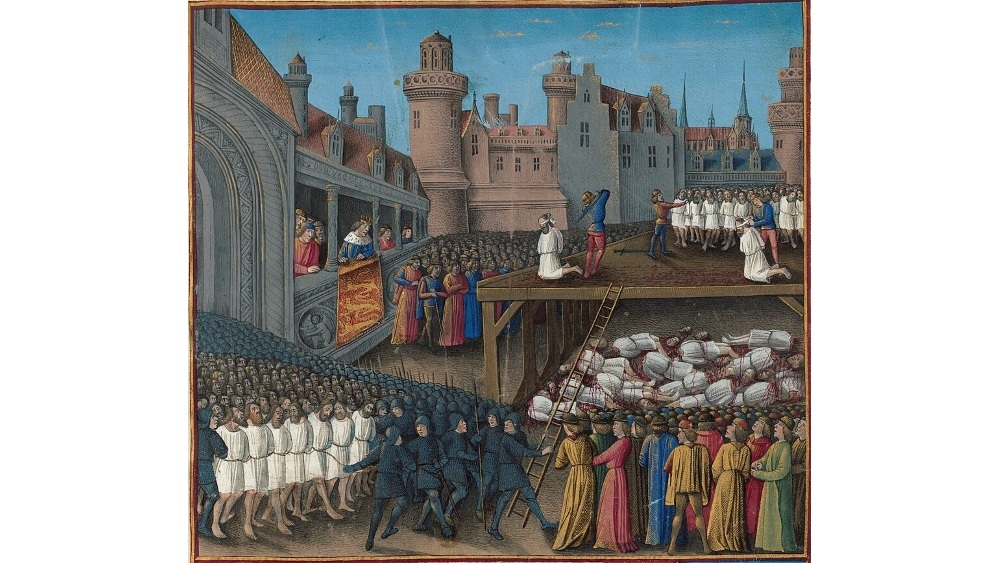
Those two orators of nuance and subtlety, Donald J. Trump and Pete Hegseth, now find themselves mirroring each other’s words in ways echoing all the way back to the 12th century and another great champion of religion, Richard the Lionheart.
It’s Hegseth, who bills himself as Secretary of War, who’s been asking us to pray for “overwhelming violence” in the “name of Jesus Christ.”
Yes, “overwhelming violence” in the name of Jesus, who famously said, according to Matthew 5:9 in the New Testament, “Blessed are the peacemakers, for they will be called the children of God.”
Naturally, wishing to put his own rhetorical eloquence on his “excursion” into the heavens above Iran, President Trump now issues a social media post, announcing that U.S. forces will target Iran’s energy infrastructure, which supplies power for millions of civilians, if the Strait of Hormuz isn’t opened for the transport of oil and gas by mid-week.
Or to put it in Trump’s own unhinged words: “Open the f—-n’ Strait, you crazy bastards, or you’ll be living in Hell – JUST WATCH.”
The president added, with apparent sarcasm, “Praise be to Allah.”
Before getting to the business of Jesus Christ as Hegseth’s champion of warmaking, let’s mention the last big guy invoking religion before he went off to slaughter as many souls as possible.

That would be King Richard I, the Lionheart of England, whose views many consider a little primitive today, with the understanding that he launched the so-called Third Crusade in his effort to capture Jerusalem more than 800 years ago.
That was a time when people’s views of God and religion were not quite as nuanced as they are today.
Or so we thought.
Richard saw himself as a champion of Christendom. In that spirit, he committed such “Christ-like” acts as the brutal murder of 2,700 prisoners.
That sounds right up Pete Hegseth’s philosophical alley. He’s called for “overwhelming violence of action against those who deserve no mercy” and “justice to be delivered without remorse. We ask these things in bold confidence in the mighty and powerful name of Jesus Christ.”
In response to all of this, we ask a simple question: Does Hegseth not know that only around 70 percent of U.S. troops identify as Christian?
The rest include Jews, Muslims, Buddhist, Hindu, agnostics, atheists and others, who signed on to fight for their country but — owing to America’s historic mix of ethnic backgrounds — might not have signed on to do any killing in the name of Jesus Christ.
But who among U.S. troops should be offended the most? Those who aren’t Christian and resent being sent into battle in the name of somebody else’s great religious figure?
Or those who are Christian and resent anyone connecting Jesus’ name with the slaughter of innocents?
Having echoed Richard the Lionheart’s embrace of Christian piety, maybe Hegseth should be reminded that the king never captured Jerusalem and never made it home from his crusade. He was killed by a crossbow attack, the wound became infected, and Richard died from gangrene.
Chances are our Secretary of War won’t get close enough to the current fighting to risk such a fate.
As for Trump, everybody knows about his proud combat record involving bone spurs.
A former Baltimore Sun columnist and WJZ-TV commentator, Michael Olesker is the author of six books, including “Journeys to the Heart of Baltimore” (Johns Hopkins University Press) and “Michael Olesker’s Baltimore: If You Live Here, You’re Home” (Johns Hopkins University).
What does it mean to be fully present with each other and the sacred, asks Maryland-born cultural anthropologist Alanna E. Cooper.
As millions mourn the passing of Stephen Colbert from the airwaves, Michael Olesker looks back on the "institution" of late-night TV.
As he gets ready to leave for California, Rabbi Daniel Cotzin Burg looks back on his time in Baltimore and his 10 years writing for Jmore.