
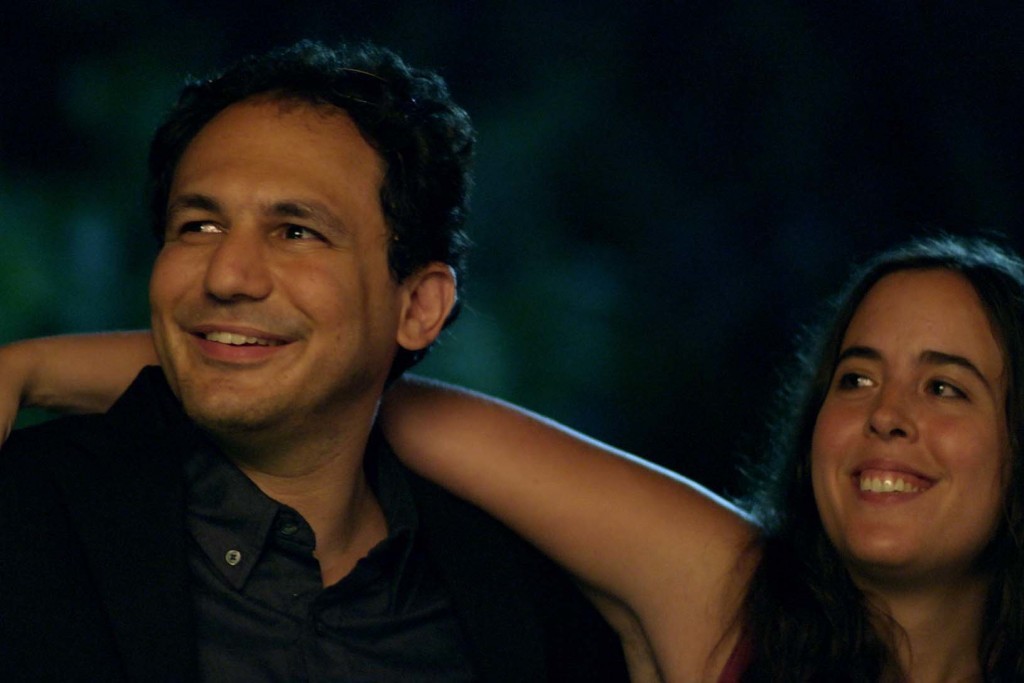
(JTA) — On the surface, the new indie comedy “Keep the Change” tells a conventional love story found in countless movies — a snooty rich boy meets a poor girl. They start dating, despite the objections of his curmudgeonly parents who assume that she’s just a gold digger. The boy and girl argue, and they part company. Ultimately, the snooty rich kid somehow finds his better self.
But the film, written and directed by Rachel Israel in her feature film debut, is far from your typical rom-com. The main characters and their friends are all on the autism spectrum, and they are played by amateur actors who are on the spectrum themselves and give professional-quality performances.
“Keep the Change” will be presented on Sunday, April 29, at 3 p.m. at the Gordon Center for Performing Arts, 3506 Gwynnbrook Ave. in Owings Mills, as part of the 30th annual William and Irene Weinberg Family Baltimore Jewish Film Festival. The festival will run from April 8 to May 3 and features more than a dozen international films chronicling various aspects of Jewish life.
The 94-minute film – which co-stars Emmy Award-winning actress Jessica Walter — is set at a real New York City Jewish community center and involves a successful program for people with autism and learning disabilities called Adaptions. Much of what is shown of it in the film mirrors the Adaptations reality — a positive community that offers social and creative opportunities for people often misunderstood by society.
In “Keep the Change,” which made its debut at last year’s Tribeca Film Festival in New York, Brandon Polansky portrays David Cohen, an arrogant rich boy ordered by the courts to attend a summer program designed for people on the spectrum after making an inappropriate joke to a police officer. He is paired up on an assignment with the quirky and outgoing Sarah Silverstein (played by Samantha Elisofon), who says she finds him sexy.

The two begin to date, but there are numerous obstacles to their relationship. David is not quite as worldly as he believes, and Sarah is far more experienced. Sarah is also likely to blurt out whatever is on her mind, which publicly embarrasses David.
“The film doesn’t mock their idiosyncrasies; it celebrates them in all their (often funny) forms,” reads a Variety review. “Uninhibited and yet often innocent and unaware, Elisofon is an endearingly off-kilter presence, while Polansky captures a moving sense of David’s desire to be ‘normal’ (something at least partially acquired from his parents) and his simultaneous yearning to be understood and accepted, warts and all.”
“Keep the Change” is often funny and heartwarming, and it takes viewers on an enjoyable journey of self-discovery. In addition, Rachel Israel’s 16-year odyssey to realize its release is as fascinating as the film itself.
In 2002, the summer before she entered the Rhode Island School of Design, Israel took a course in nude drawing at a Florida college. Polansky was a student in the class, and as Israel recalls, he spent breaks “walking around the room hitting on every female” in the room.
At the time, Israel said she recognized he was different but not that he was on the spectrum.
“I wouldn’t have guessed autism,” the filmmaker said in a recent telephone interview from her home on Manhattan’s Upper West Side, just three days after giving birth to her second child. “My view from Hollywood was that autistic people are introverted. They don’t seek social connections. They definitely don’t like crowds.”
Even though she turned down a date, Israel gave Polansky her phone number and the two stayed in touch.
“He kept calling and we’d have these phone chats once or twice a week,” she said. “It wasn’t until a year or so of knowing him that he opened up enough to tell me he had autism.”
Polansky told Israel of his frustrating efforts at online dating, about “going to bars or big parties trying to meet people, often meeting with insensitive responses.” She counseled Polansky and began to see how these events could work cinematically, especially after he found his first girlfriend through the Adaptations program. That experience changed him, gave him increased self-confidence and “inspired the writing” of the screenplay, Israel said.
In 2011, Israel decided to turn the story into a short film thesis for her master’s of fine arts program at the Columbia University School of the Arts. The entire shoot took less than five days, and the final product won several accolades, including the top award at the school’s film festival.
Israel then set about developing a feature version, which meant expanding the cast. She asked other members of the Adaptations community at the Marlene Meyerson JCC Manhattan to play characters on the spectrum.
Directing them sometimes required special patience and understanding, Israel said. Some were able to see their role as part of a greater whole, while others could only see as far as their lines.
“All of them were terribly generous and open with me. It was challenging, not uncomfortable,” Israel said. “What was frustrating was raising funding. I had the commitment of the cast and their faith that it would happen.” (The film eventually received funding support from the Sundance Institute, the Rooftop Film Festival and the Princess Grace Foundation.)
Asked what she hoped audiences would take from the film, the director said, “It’s a love story. I hope they walk away with the warm glow of a love story.
“In terms of autism, I hope it opens up a whole world of people in a very humane way.”
For information about the Baltimore Jewish Film Festival, visit jcc.org/gordon-center/film.
Curt Schleier writes for the JTA international news agency and wire service.
“Keep the Change” is at the Baltimore Jewish Film Festival at the Gordon Center April 29, 3 p.m. Go here for tickets.
Filmmaker Justin Schein looks at wealth and inequality through the very real story of his late father.

For 35 years, the late Deborah Brodie, aka Bubbie Cookie, amassed a collection of over 200 Jewish ritual objects, which she used to teach her Hebrew school students with special needs.

Conceived by Columbia resident Benjamin Kintisch, "Life Review: The Hospice Musical" offers a thought-provoking and occasionally amusing perspective on mortality.
Steve Hofstetter, who will perform at Soundstage next week, recently made headlines for his social media post ridiculing some fans' warnings about Charm City's safety.