
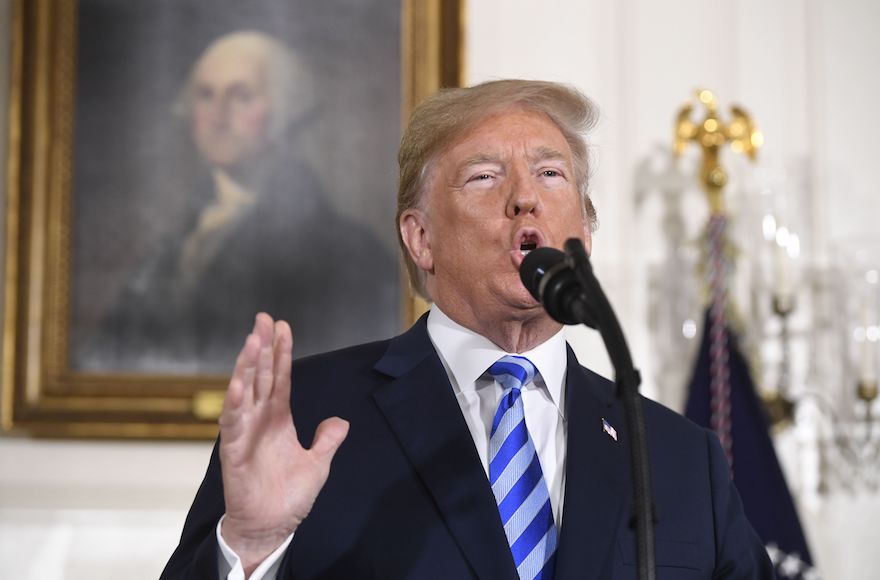
Once more, President Trump tries to make America the most divided nation in history, and a people most frightened by our fellow citizens.
Not satisfied with dividing us by our current troubles — his indifference to the coronavirus victims, his sending of the storm troopers nobody wanted, his callousness toward the late Rep. John Lewis — he now rummages through the trash heap of history to open old, festering wounds.
“I am happy to inform all of the people living in their Suburban Lifestyle Dream,” he tweeted the other day, “that you will no longer be bothered or financially hurt by having low income housing built in your neighborhood.”
Somewhere in their graveyard disgrace, George P. Mahoney and Dale Anderson must be applauding such language.
Remember them?
It was Mahoney who ran for governor of Maryland in 1966 with the campaign slogan, “Your home is your castle — protect it.”
Everybody knew what he meant. In an era when black people were finally starting to imagine fair housing opportunities, Mahoney was trying to stand in their way. He was telling white people, “Don’t let these blacks move into your neighborhood. Vote for me.”
Then we had Anderson, in the 1970s, who was Baltimore County executive. In that time, the county was 93 percent white.
Anderson declared there would be no low-cost housing in his county. He turned away millions of dollars in federal grants rather than build housing for poor people — because, as Anderson signaled, poor people would probably be black.
When a U.S. civil rights commission studied county housing and racial policies, they described Baltimore County as a “white noose” strangling the city of Baltimore.
None of this would have been news to Donald Trump, who has always cashed in on race.
His family firm — in which Trump was president and his father, Fred, was chairman –owned 14,000 apartments. In one of the biggest housing discrimination lawsuits, the Justice Department charged the firm with violating the Fair Housing Act of 1968. The Trumps didn’t want to rent to people of color.
Trump’s latest gesture is just a variation on a familiar theme.
Five years ago, Trump was making some of his famous racist pitches, about Barack Obama’s birth certificate, and Mexican rapists and Muslim immigration.
Around that time, the Obama administration championed The Affirmatively Furthering Fair Housing (AFFH) Rule. This required local governments receiving federal money to get specific about their efforts to de-segregate.
And so, as the Washington Post put it, Trump moved the other day “to repeal that rule, with language that appeared to hark back to an era of Whites distancing themselves from Black Americans.”
That was Trump tweeting about low-cost housing and “Suburban Lifestyle Dreams.”
He was about as subtle as Dale Anderson or George P. Mahoney.
By the way, Mahoney never did get elected. In that race for governor of Maryland, the winner was the future vice president of the U.S., Spiro Agnew.
And how did Agnew reach such political heights? In the aftermath of the 1968 riots, following the assassination of Dr. Martin Luther King, Agnew summoned about a hundred of Baltimore’s African-American leaders.
They were respected community healers, judges, political figures, neighborhood organizers, ministers. They weren’t the so-called radicals whom Agnew loathed. These were moderates, who had spent their lives carefully espousing mainstream American values and appealing to the country’s sense of conscience.
He blamed them for the riots.
“You ran,” Agnew told them. He said they were afraid of being called “Uncle Tom.” He said they should never have let the rioting happen — as if they possessed some magical control of the streets, as if they alone might have calmed generations of pent-up rage, as if their grief wasn’t profound enough over King’s death.
As if Agnew, and generations of insensitive white politicians before him, weren’t the ones who had actually created this moment.
And what happened then?
Agnew was flooded with congratulatory white reaction — including, shortly thereafter, a phone call from Richard Nixon, who heard about Agnew’s racist remarks and said to himself, “I can use this guy.”
Thus, out of the great American racial divide, the previously little known Agnew became Nixon’s vice president — and, until he was caught taking bribes, a wildly popular figure to conservative whites.
Half a century later, maybe Donald Trump pays more attention to history than we thought.

A former Baltimore Sun columnist and WJZ-TV commentator, Michael Olesker is the author of six books, including “Front Stoops in the Fifties: Baltimore Legends Come of Age” (Johns Hopkins University Press).
A new biography on the creator of "Doonesbury" misses the mark, writes Michael Olesker.
What does it mean to be fully present with each other and the sacred, asks Maryland-born cultural anthropologist Alanna E. Cooper.
As millions mourn the passing of Stephen Colbert from the airwaves, Michael Olesker looks back on the "institution" of late-night TV.

As he gets ready to leave for California, Rabbi Daniel Cotzin Burg looks back on his time in Baltimore and his 10 years writing for Jmore.