
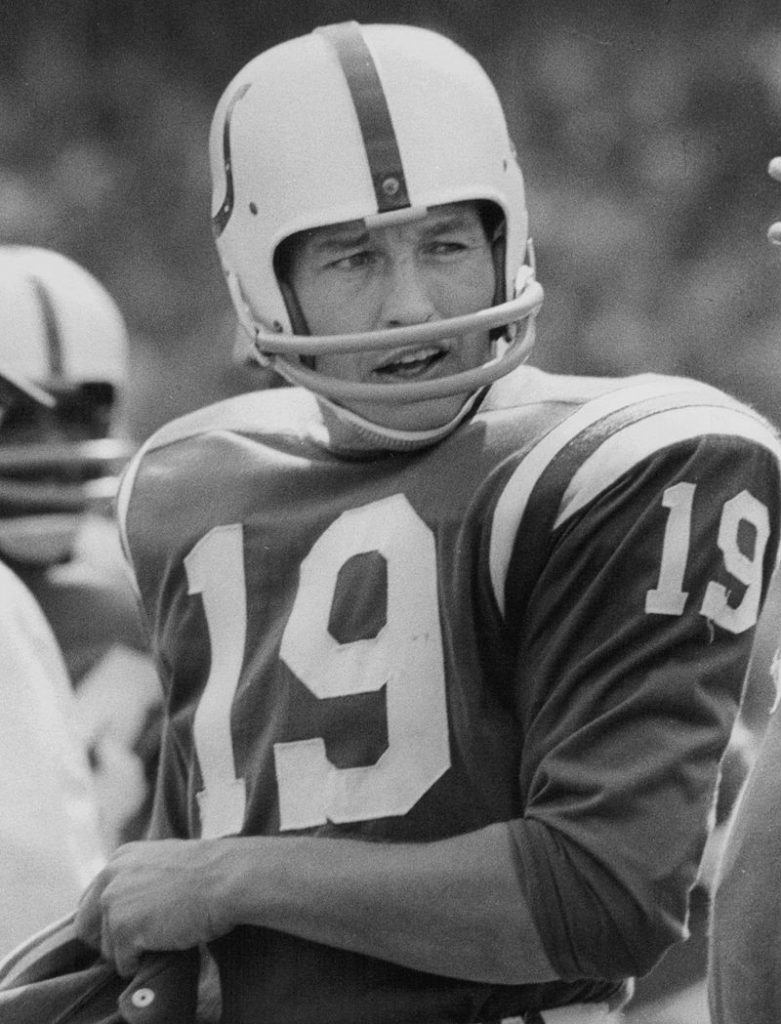
Don’t look now, but we’re approaching the 60th anniversary of the only National Football League championship game that was ever played – or ever will be – in Baltimore, no matter how many Super Bowls the Ravens might win.
They don’t play any Super Bowls in outdoor stadiums in coldweather climates.
But six decades ago – on Dec. 27, 1959 – a team called the Baltimore Colts, at a 33rd Street ballpark called Memorial Stadium, defeated the New York Giants, 31-16, for their second straight pro football championship.
History vividly recalls the previous year’s game – the one many still call “the greatest game ever played” – when the Colts defeated the Giants in Sudden Death overtime, 23-17.
For a generation alive so long ago, the ’58 game lingers inmemory – national memory, not just Baltimore’s – so compellingly that it’stended to blot out recollection of the following year’s victory.
But the ’59 game had cachet of its own.
For one brief, shining moment, Baltimore itself was theCamelot of pro football. The Colts were America’s Team, and Baltimore was the raucousmunicipal model for all NFL cities.
Sixty years ago, there was John Unitas, winning the game’sMost Valuable Player award for the second year in a row. There he was, in theColts’ very first possession, throwing to Lenny Moore, who ran away fromeverybody for a 60-yard touchdown.
There were Gino Marchetti and Big Daddy Lipscomb and ArtieDonovan, swarming all over the Giants’ offense, and there was Johnny Sample,intercepting two passes and batting down another.
Against a brutal Giants’ defense, the Colts entered the fourth quarter trailing 9-7. But Unitas passed for a touchdown to backup receiver Jerry Richardson, and then Unitas ran for another TD, and Sample returned one of his interceptions for a score.
The Colts scored 24 unanswered fourth-quarter points for a 31-9 lead, and then gave up a meaningless late score to New York.
If you didn’t have a ticket to the game – and there wereonly about 60,000 available – you were in trouble. In those days, the NFLdidn’t televise home games, even when a championship was on the line.
The closest TV coverage was a Washington station. SoBaltimoreans without a ticket learned to wrap aluminum foil around their TVantennas, and the lucky ones managed to get fuzzy black-and-white reception ofthe contest.
After 60 years, memories are fuzzy as well. But it was a glorious time for Baltimore. We had never seen a championship game played on our home turf, and likely never will again.

A former Baltimore Sun columnist and WJZ-TV commentator, Michael Olesker is the author of six books. His most recent, “Front Stoops in the Fifties: Baltimore Legends Come of Age,” was reissued in paperback by the Johns Hopkins University Press.
A lifelong Orioles fan, Jmore Publisher Scott Rifkin, M.D., shares a message to Orioles owner David Rubenstein.
Attorney and Barry Levinson confidante Donald Saiontz left his mark on the world, writes Michael Olesker.

When we create a world with a warm and loving connection, even when someone beloved is gone, that relationship is carried on, writes Pamela R. Weissman.

The Orioles this season have proven that money can't buy happiness, writes Michael Olesker.