
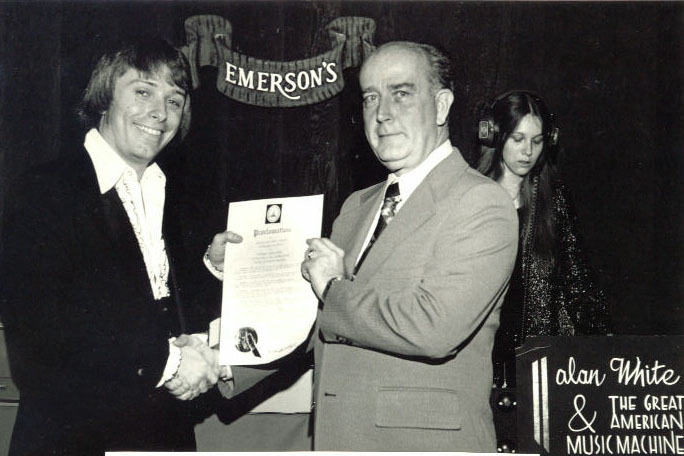
In our current coronavirus-enforced isolation, I’m re-reading C. Fraser Smith’s terrific 1999 biography of William Donald Schaefer, who died nine years ago this week. It’s inspiring to recall the caustic, cranky mayor and governor who taught a beaten city to believe in itself.
But it’s depressing to measure the distance between his readiness to run the town and the current list of contenders.
Vagrant snapshots of Schaefer emerge from memory. How about the time he walked into City Hall and George Baumann, the late WJZ-TV anchorman and political reporter, greeted him?
“Good morning, Mr. Mayor,” Bauman said happily. “You’re looking well.”
“Nope, no I don’t,” Schaefer replied, walking past and never breaking stride. “My head’s too big, and I walk like a duck.”
That line evoked memories of Schaefer wading into the seal pool at the National Aquarium’s opening in 1981, wearing a zebra-striped, turn-of-the-century swimsuit with an inflatable Donald Duck in his hands and a deadpan, Buster Keaton expression on his face.
He certainly knew how to seize a moment. But far more important, as Smith’s book “William Donald Schaefer: A Political Biography” (Johns Hopkins University Press) reminds us, he understood where his city had been and what it needed, and where it had to go to survive.
Schaefer did three things important for any leader, the first being the most important: He surrounded himself with really smart people, such as Bob Embry and Charles Benton, George Russell and Clarence “Du” Burns, Joan Bereska and Marion Pines, and Janet Hoffman and Sandy Hillman.
It’s tough to find such caliber of people today. Baltimore’s overall population isn’t the only thing that’s diminished over the years. There’s been a brain drain of the brightest lights as well. Not only do we lack hitting and pitching, but there’s no political bench strength either.
Schaefer also understood the value of salesmanship. He was on TV all the time, telling us “Baltimore is best” even when we knew it wasn’t, rallying us to come downtown for the tall ships or the City Fair or the once-great ethnic festivals or Harborplace –- or that comical opening of the aquarium.
In that sense, Schaefer was lucky. He served as mayor in a time when local TV news was peaking. Today, their ratings are a tiny fraction of yesteryear’s, much like newspapers’ dying numbers. So how does any mayor get a message out to a single mass audience today?
But Schaefer’s other great strength is that he knew the turf, knew it intimately and knew every section of town from its bricks to its bloodlines. He’d grown up here, gone to our public schools, worked as a downtown attorney, and spent years on the Baltimore City Council and as Council president.
In all those years leading up to his first mayoral run in 1971, Smith writes, “[Schaefer] was learning how to prepare budgets, how the scrambled zoning laws were failing, the importance of housing code enforcement, the need for a housing court, who the leaders were in the police and fire departments, and who could get something done for you in public works.”
As the city prepares for the next mayoral election, is there a candidate out there who even vaguely approximates such a background?
Every year as mayor, Schaefer would head down to Annapolis to beg, plead, pressure, bribe -– do whatever was needed to steer state money to Baltimore. It’s how the city got ballparks, Harborplace and countless public works projects.
But there was a breathtaking trip to Washington, too, that characterized the Schaefer style. He met with George W. Romney, who was Richard Nixon’s secretary of the U.S. Housing and Urban Development. Romney tried to stiff him on some big federal development money needed by the city.
Schaefer felt the need to vent a little.
“You don’t understand what’s going on in cities,” he hollered at the distinguished HUD secretary. The patrician Romney hollered back. So Schaefer upped the ante.
“You sit here and pretend to care,” he shouted. Schaefer started calling Romney unprintable names. He pounded on the table. He wasn’t just the mayor of Baltimore, he was a guy up from a tough city’s street corners, ticked off and tired of hearing “no” from big shots in fancy offices who controlled massive government money.
When he left Washington that day, Schaefer figured he’d blown it. He didn’t know his own power. Romney got the message. Weeks later, the federal dollars started coming in for several big development projects.
Can you imagine any of the current mayoral candidates with that kind of chutzpah? In the current coronavirus situation, the primary election’s been pushed back to June 2.
These candidates should use the time to read Fraser Smith’s “William Donald Schaefer: A Political Biography.” They might learn a few things about how to be a mayor.

A former Baltimore Sun columnist and WJZ-TV commentator, Michael Olesker is the author of six books. His most recent, “Front Stoops in the Fifties: Baltimore Legends Come of Age,” has just been reissued in paperback by the Johns Hopkins University Press.
The former Colt, who passed away on May 25 at age 93, achieved immortality during a cold December day in 1958, writes Michael Olesker.
A new biography on the creator of "Doonesbury" misses the mark, writes Michael Olesker.
What does it mean to be fully present with each other and the sacred, asks Maryland-born cultural anthropologist Alanna E. Cooper.
As millions mourn the passing of Stephen Colbert from the airwaves, Michael Olesker looks back on the "institution" of late-night TV.