

For Noah Himmelstein, the art of theater is a beautiful, healing experience.
Himmelstein serves as associate artistic director of Baltimore’s Everyman Theatre. He directed the upcoming production of Thornton Wilder’s Pulitzer Prize-winning play, “The Skin of Our Teeth,” which runs from Dec. 7 through Jan. 2 at Everyman, 315 W. Fayette Street.
Jmore recently caught up with Himmelstein, 36, a Pikesville native, to talk about this production, the role of theater right now in American culture and what guides his work.
Jmore: Tell us about the significance of directing ‘The Skin of Our Teeth’at this moment in history.
Himmelstein: ‘The Skin of Our Teeth’ is an extraordinary play. It’s a very fantastical, mystical play about a family traveling through 5,000 years of human history. But underneath, there’s a deep resonance of people facing obstacles. Whatever you’re dealing with in life, this play brings it to the fore. There’s a famous quote of Thornton Wilder that this play really comes to life in times of crisis.
What’s so wonderful about this play is that it’s a very stylized, heightened comedy, but it’s a brilliant satire that is pretty deep. And so it takes us out of ourselves and returns us deeper into the moment.
The theater I’m longing for operates in metaphor, which is the best kind of theater. It really is a hilarious, silly, delightful play with substance. It’s the best kind of play to return to work with.
How did you make the play relevant for today?
We didn’t change the words, but we are looking at it and turning over every line and asking questions about how will that be heard. And how does that feel to us. Because it has to exist for this moment, even though it was written during World War II.
From the moment the curtain goes up, you’re going to feel like this is a contemporary take on it, and yet it is all very 1940s-inspired. I’ve been working with an extraordinary design team, and that has been thrilling.
Why should audiences come back to the theater at this time?
It is the most healing, cathartic experience. It’s a religious experience to be in a room together, sharing a piece of art. We’re all in a different place than we were two years ago, and we’ve all been through something together. Now it’s time for us to make art together again, informed by all of this growth.
There’s really nothing like being in a room full of people safely. It’s exhilarating to be back in the theater. I think theater is an incredible night out, and I’m really leaning on the joy. After two years of Zoom and TV, this is the kind of theater I want that you can’t get anywhere else.
How has theater changed during the pandemic?
In almost every theater across the country, everyone is reevaluating what our role is. What is an artist’s relationship to the community? What is the theater’s role in a community? Are we improving people’s lives? Are we equitable?
‘The show must go on’ mentality is — for the better — shifting. Artists should not be left out of a weekend. Customarily, it was one day off. Six days is a lot, especially with the vulnerability and the strength it takes when your craft is your body.
We are all questioning structures that have been in place so long. At Everyman, we adjusted our rehearsal schedules for all the shows this season to have a better work-life balance. That’s been a real culture shift for the whole industry. We are real people here and we are putting our hearts out to tell a story.
How does Judaism guide your work?
I’m influenced a lot by a writer and thinker named Abraham Joshua Heschel. His writings, particularly about the Sabbath as ‘a palace in time,’ are kind of my mantra on directing theater. I go back to his work a lot in thinking about creating time and space. My philosophy as an artist is directly impacted by spirituality.
How did you grow up?
I grew up in Pikesville and attended Temple Oheb Shalom. I was always a theater kid. I went to Carver Center for Arts and Technology in Towson for high school, where I was a theater major. I had incredible teachers at Carver, and they’re still in my life, and they’re still supportive of me.
I moved to New York City in 2007. Now I split my time between Baltimore and New York.
What does it mean to come full circle back to Baltimore?
It’s incredible to have an artistic home here to work out ideas and to grow as an artist with a community. I know a lot of our audience. We have a rich, diverse audience in Baltimore.
I’m very conscious of a long-term conversation here. And that’s the gratifying thing of having a home at a theater. It’s not just, ‘We put on a show, it runs for four weeks, what’s the next one?’ It’s about these long conversations about how you impact the community, our educational programs like the High School Matinee Program, which provides Baltimore City students access to Everyman’s productions completely free of charge. Some of those students then become artists who work at the theater.
That’s where you really feel, ‘Oh, this is the role of an artistic space within a community.’
Anna Lippe is a freelance writer based in Washington, D.C.
Schools in Montgomery County have recently experienced a wave of antisemitic incidents.

Filmmaker Justin Schein looks at wealth and inequality through the very real story of his late father.

This year’s Community Block Party at the JCC of Greater Baltimore will feature classic cars, giant inflatables, games, a rock-climbing wall and roller skating rink, and strolling entertainers.
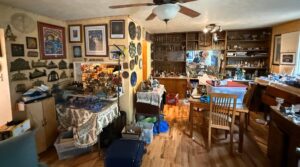
For 35 years, the late Deborah Brodie, aka Bubbie Cookie, amassed a collection of over 200 Jewish ritual objects, which she used to teach her Hebrew school students with special needs.