
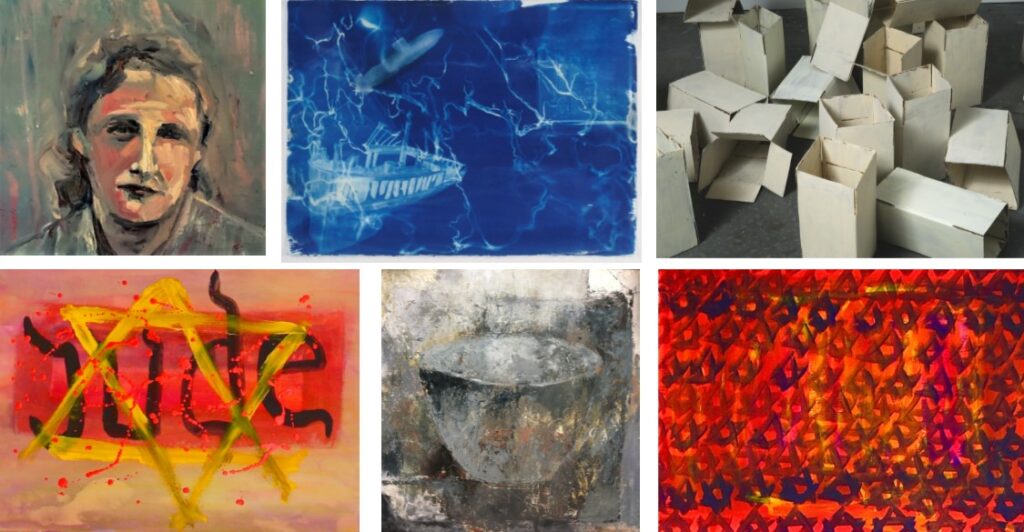
Just before the pandemic hit, I interviewed several artists who were part of an exhibition set to open at Howard Community College in Columbia.
“Creative Quest: Art From the Holocaust’s Second Generation” features works by local artists Trudy Babchak, Chaya Schapiro, Micheline Klagsbrun, Miriam Morsel Nathan, Margot S. Neuhaus, Mindy Weisel and Coos Hamburger, all children of Holocaust survivors.
“Creative Quest” was curated by Babchak, Toby Brookes, Nancy Kutler and Schapiro.
The exhibition’s opening was postponed due to COVID-19. But fortunately, members of the community have another chance to view “Creative Quest,” which opened at the college’s Horowitz Center for Visual & Performing Arts in March and is on display through Apr. 28.
Jmore recently spoke with Coos Hamburger, a Baltimore County resident and photojournalist whose images appear in the exhibition.
Jmore: The world is a very different place than when I last interviewed you. What’s it like to open the show post-pandemic?
Hamburger: COVID created a set of circumstances that were by no means analogous to what our parents went through [during the Holocaust] but allowed us to know what some of their fears and feelings were like. [For example] not knowing what the following day would bring or what the conditions were going to be. We’re constantly barraged with horrific news, people disappearing because of illness and inability to get basic services. The difficulty of obtaining food and health care, the difficulty of going to work. The worry about where for many in our society the next paycheck is going to come from. And a profound sense of social isolation.
Until now these have been theoretical concepts for us, things we could only imagine from stories.
How about the impact of the war in Ukraine?
I think that is different for each of us in the group. I think we all have a sense of the horror of war in general. The location of this particular war affects some of us because they are the historical roots of our families. To know that murderous events are occurring again, where once pogroms occurred and so forth, I think it drives it home.
Why do you choose to express yourself through photography?
I think photography captures moments in perpetuity, and a photograph gives us a freeze frame of life. That allows us afterwards to look back and reflect in a very conscious way about that moment. And I think that’s important. Life goes by so quickly. And there are significant events, both good and bad or moments of beauty that we want to last, or moments of pain that we want to understand or moments of difficulty that we want to ameliorate.
I think looking at a photograph of those events raises our consciousness beyond that moment and gives us a chance to contemplate what that moment really means, how it affects others and how it affects us.
How did you go about deciding what photographs would be in the show?
Before the pandemic, I had actively chosen not to include anything that that had direct lineage to [the Holocaust]. But as I was going through the pandemic and preparing for this exhibit I started thinking, ‘Is there a tie?’ Quite frankly, until I became involved with this, I didn’t actively think about that. I mean, my photography was my photography. I chose the topics that I chose because I found them interesting, important, relevant or significant.
It wasn’t until we all got together and we had sort of this group discussion that I spent a lot of time thinking about, ‘Well, does being a second-generation inform my photography?’ The more I thought about it, I realized that the ties were very much there. As I put the photographs together for the exhibit, I realized it’s important to have two pieces that [have a] direct connection.
One of those photos is the one you took of the train in the Terezin concentration camp. Tell us about that.
I was walking in Terezin with my mother, and she stopped at that spot and said she recognized the building and the general location geographically and architecturally. She said, ‘This is where the train station was. This is where I last saw my father.’ He was sick and they put him on a stretcher and she was able to walk with him [to the train]. And then they threw them on the train, and that was the last time. So that was a traumatic moment
[After that] I was doing some research and came across a photograph taken in 1943 by the Germans of the train in Terezin. I thought to myself, ‘Why does this look familiar to me?’ And lo and behold, I find exactly the same location in my photograph. It’s very unusual to find a photograph that matches a memory where you weren’t there to create the memory.
So I decided to include that photo here. I wasn’t originally going to use it because I didn’t think that the image itself is artistically all that important. It’s a good photograph, but it’s not a photograph that I would typically say this reflects my work. But in the context of the story and in the context of having the exact same spot photographed in 1943, that picture takes on a whole different significance.
What would you say about the other artists in the exhibit?
If the purpose of art is to make us think and feel and make us ponder a relationship to one another and the world, I think the art that these artists brought to this exhibit made me do all of those. I look at the work and I identify with it instantly, intimately and completely. And it’s rare for me to feel that way.
And it’s fascinating because I’ve gone to the exhibit with friends and they look at my photographs or they look at some of the other artwork and they say, ‘I like the use of color’ or ‘I like the use of form’ or ‘I like the subject’ or whatever the case may be. ‘But what is this supposed to represent?’ And I look at them and I’m just stunned. I mean, how can you not see it? And then I realize they can’t see it because they don’t have my history.
When I look at the work of these other artists, it’s not a secret code to me. It’s as obvious as reading a narrative in a language that I understand intuitively.
If that’s the case, what can an exhibit like this teach the general public?
One of the beauties of doing it with Howard Community College is that it is a diverse group of young people, and if nothing else it might cause some of them to ask, ‘What is a second generation? What is the Holocaust?’ Because some of us are less educated about it. There is a growing segment of the population for whom this is maybe something that happened in history or a completely foreign concept.
I think one of the things that we want with this exhibit is to have people look and ask questions as to why are these pictures here and why is this work group together and what is it that ties these artists together. And maybe some of them will walk away and say, ‘I never knew this happened.’ Or maybe some people will walk away and say, ‘I knew what happened. Maybe I should do more to make sure it never happens again.’
Howard Community College is located at 10901 Little Patuxent Parkway. For information about the exhibition, click here.

Enjoy some live music this fall, with a range of performances from The Ultimate Prince Tribute to Journey, classical and more.

For Aja Cohen, founder and chief creative officer of Transcendent Active, a modest activewear brand, the company is a reflection of her entire journey -- fashion, faith, movement, motherhood and identity.
Emma Snyder, owner of The Ivy Bookshop, offers recommendations for must-read titles for adults and children.

Marc Terrill talks with Ken Muskat, President for Scenic Group USA and Latin America, about the evolution of the cruise industry, why curated cruise and yacht experiences have become the fastest growing segment of the leisure market, and more.