

Countless actors dream of snagging a Broadway role, but only a select few ever land one. Baltimore native Betsy Rosen is one of those talented and fortunate few.
This month, she will make her Broadway debut in a stage adaption of Yann Martel’s best-selling novel, “Life of Pi.” Previews for “Life of Pi” began at the Gerald Schoenfeld Theatre on Mar. 9. The show will open on Mar. 30.
Rosen is one of three actor/puppeteers who will work in concert to portray the show’s 450-pound Bengal tiger named Richard Parker. She plays the tiger’s heart.
Rosen, 39, who grew up in Reisterstown and now resides in Queens, New York, has been performing since she was 5 when she appeared in local dance, ice skating and community theatrical productions. But she really caught the theater bug at age 8 when she joined Reisterstown’s Open Space Arts theater group.
“One day, my dad was riding his bike down Main Street and saw these people on the front porch doing stuff,” Rosen says. “He asked, ‘What are you doing?’ And they said, ‘Oh, we build puppets and do theater shows and offer classes and things like that.’ He came home, told my sister and me, and I immediately said, ‘I want to do it, whatever it is.’”
For the next decade, Open Space Arts became her “second home. I did every summer festival. I took all of their acting classes,” says Rosen who became a bat mitzvah at Beth Israel Congregation in Owings Mills.
After graduating from Franklin High School, Rosen attended the University of Maryland, College Park, majoring in theater and mathematics. Her math background enabled her to find regular employment as a teacher and tutor, which made it possible for her to pursue an acting career.
Over the years, Rosen performed mainly in regional productions. Her credits include roles in “A Christmas Carol” at Delaware Theatre Company, “The Lion, the Witch and the Wardrobe,” at Imagination Stage in Bethesda and “Pride and Prejudice” at the Roundhouse Theatre in Bethesda.
Last year, after a rigorous audition process, Rosen was cast as the tiger heart in “Life of Pi’s” first U.S. production at the American Reparatory Theatre in Cambridge, Massachusetts. “Life of Pi,” tells the story of a 16-year-old boy marooned on a lifeboat along with a hyena, zebra, orangutan and Royal Bengal tiger.
“It’s a story about survival,” says Rosen. “But I think it’s also a story about how we cope with trauma, the stories we need to tell ourselves in order to cope with trauma and tragedy and how we find strength within ourselves to continue on.”
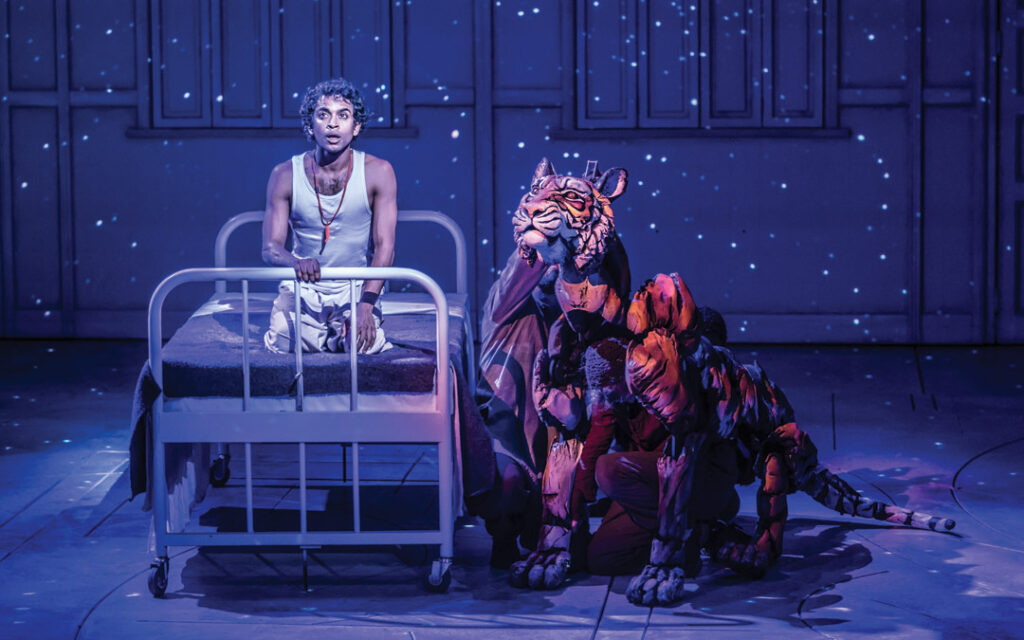
Rosen says the tiger’s heart is the most challenging role of her career.
“The tiger puppet is three puppeteers,” she says.
“There’s one puppeteer on the outside of the puppet on the head, one puppeteer outside the puppet on the hind doing the back legs. And then there’s one puppeteer who’s inside, which is me. I use my hands to move the front paws, and my spine is along the interior spine of the tiger. We all connect to each other through the spine. We don’t speak to each other when we’re performing. We breathe together and listen. We use the spine to ‘pass the ball,’ as we say to each other. So I put breath into my body that goes into the tiger and then into the head and into the hind. And they can pass the ball to me front and back and back to front.”
In addition, Rosen and her colleagues have studied the sounds that animals make to create realistic portrayals of their characters. In fact, when she’s not acting as the tiger heart, Rosen plays other animal characters in the show.
“There’s something about the primal nature of these characters,” she says. “I don’t know that I’ve ever had to do anything quite like playing a tiger that rips apart a goat at one moment in the show. What does it have to feel like to have that animal instinct?
“We put this whole show up in six weeks, so it was a steep learning curve. Even though I have technically 30 years of puppetry experience, every puppet is different, so you have to learn this puppet and then you have to learn how to work with these other teammates. That’s also what makes the puppetry in this show so magical, that we really are making these animals real, for the audience to believe that they are real. One of my favorite things about puppetry is if you’re doing it right, within moments the puppeteers disappear.”
For information, visit lifeofpibway.com.

Filmmaker Justin Schein looks at wealth and inequality through the very real story of his late father.

For 35 years, the late Deborah Brodie, aka Bubbie Cookie, amassed a collection of over 200 Jewish ritual objects, which she used to teach her Hebrew school students with special needs.

Conceived by Columbia resident Benjamin Kintisch, "Life Review: The Hospice Musical" offers a thought-provoking and occasionally amusing perspective on mortality.

Steve Hofstetter, who will perform at Soundstage next week, recently made headlines for his social media post ridiculing some fans' warnings about Charm City's safety.